
A complete mortgage closing checklist includes final loan approval, a clear title review, homeowner’s insurance proof, a government-issued ID, and certified funds for closing costs. Munshi Capital Inc. guides buyers through underwriting and closing with full transparency, confirming loan terms match the Closing Disclosure before signing, preventing last-minute surprises on closing day.
Key Takeaways
- Review your Closing Disclosure document at least three business days before signing day.
- Verify all loan terms, interest rates, and final costs match your pre-approval paperwork exactly.
- Bring valid government-issued identification and proof of homeowners insurance to your closing appointment.
- Conduct a final walkthrough of the property within 24 hours before closing to confirm agreed repairs.
What Is Included In A Mortgage Closing Checklist?
A mortgage closing checklist covers the documents, disclosures, and financial steps a borrower must complete before receiving the keys to a property. Closing represents the final and most consequential stage of the homebuying journey, according to the Consumer Financial Protection Bureau, which makes a thorough closing-checklist-043 essential rather than optional. Skipping items on this list risks delayed funding, unexpected costs, or a closing date that slips entirely.
At Munshi Capital, the checklist connects directly to a broader philosophy: a straightforward application, underwriting, and closing process built to eliminate surprises for borrowers. First-time buyers and seasoned investors alike move through the same mortgage-closing-steps-043, regardless of loan type.
What documents does a buyer need before closing?
Buyers typically need a government-issued ID, proof of homeowners insurance, and final bank statements verifying funds for closing costs. Loan officers also confirm employment and income one final time before documents go to the title company. Missing paperwork at this stage is one of the most common causes of closing delays.
A complete checklist generally includes:
- Review of the closing disclosure for accuracy
- Confirmation of the final loan terms and monthly payment
- Verification of wire instructions directly with the lender or title company
- Proof of homeowners insurance coverage
- Government-issued photo identification
Technology plays a defined role in this process. Munshi Capital pairs loan specialists with digital tools. Borrowers see loan status at every stage, from pre-approval through the final signature. That visibility matters most in the days before closing, when last-minute requests can otherwise catch buyers off guard. Borrowers who understand each requirement in advance close with far less stress and fewer last-minute scrambles.

What Should You Do Before Your Closing Appointment?
Preparation before closing centers on document review, financial verification, and final confirmation of loan terms. Lenders schedule closing after an offer gets accepted. This timing gives buyers a defined window to complete a closing checklist and resolve outstanding questions. That timeline matters: rushing through final steps increases the risk of surprises at the table.
Munshi Capital’s quick pre-approval process gives buyers full visibility into loan status well before that appointment date. Instead of guessing where an application stands, buyers see progress at each stage. This transparency allows time to address discrepancies before they become delays.
What documents should buyers gather first?
Buyers should collect government-issued identification, proof of homeowners insurance, and a final copy of the closing disclosure. Bank statements and proof of funds for closing costs also belong in this stack. Having these ready prevents last-minute scrambling.
How does working with a transparent lender change preparation?
A lender that walks buyers through application, underwriting, and closing step by step removes much of the guesswork from these mortgage closing steps. Buyers working with Munshi Capital move through each stage with clear expectations set in advance, rather than discovering requirements at the appointment itself.
Before signing day arrives, buyers benefit from a short pre-appointment review:
- Confirm the final loan amount, interest rate, and monthly payment match earlier estimates.
- Verify the exact funds needed and the accepted payment method.
- Review title and insurance documents for accuracy.
- Resolve any last questions with the loan team in advance.
Munshi Capital’s focus on integrity and personalized service means buyers enter their appointment informed, not uncertain. A well-prepared buyer treats the day-of-closing checklist as a formality rather than a hurdle. Clear communication beforehand, not scrambling during the meeting, determines how smoothly ownership transfers.

What Are The Key Mortgage Closing Steps?
Mortgage closing follows a defined sequence: document review, signature, fund transfer, and recording. A complete closing checklist keeps buyers from missing a single piece during this final stretch. Skipping a step here risks delaying the transfer of keys, or worse, derailing the deal after months of work.
The heart of the process happens at the signing table. Buyers review and sign loan documents, including the mortgage note and the closing disclosure, which spells out final loan terms and costs. These mortgage closing steps confirm what the buyer owes, what the lender provides, and what the title transfer requires. Nothing moves forward until every required signature is in place.
Loan type shapes what documents appear in that stack. Residential programs such as FHA, VA, USDA, and bank statement loans each carry distinct paperwork and underwriting requirements. Commercial loan programs add their own layer of review. For buyers weighing eligibility ahead of time, resources covering VA Loan Eligibility Requirements Explained for First-Time Buyers and USDA Loan Eligibility Requirements for First-Time Buyers outline requirements before the paperwork stage begins. Munshi Capital’s lending team guides borrowers through each stage of this sequence, aiming for clarity and speed rather than confusing jargon or last-minute surprises.
What Documents Get Signed at Closing?
Buyers sign the mortgage note, the closing disclosure, and title transfer paperwork. Each document confirms a specific piece of the loan: repayment terms, final costs, and legal ownership. Reviewing these pages before the appointment prevents rushed decisions at the table.
How Does a Lender Keep Buyers Informed During Closing?
Munshi Capital pairs loan-tracking technology with hands-on service from loan specialists. Borrowers get visibility into document status and next steps without having to chase updates. That combination of transparency and attention matters most in the final stage, when a day-of-closing checklist separates a smooth handoff from a stressful one.
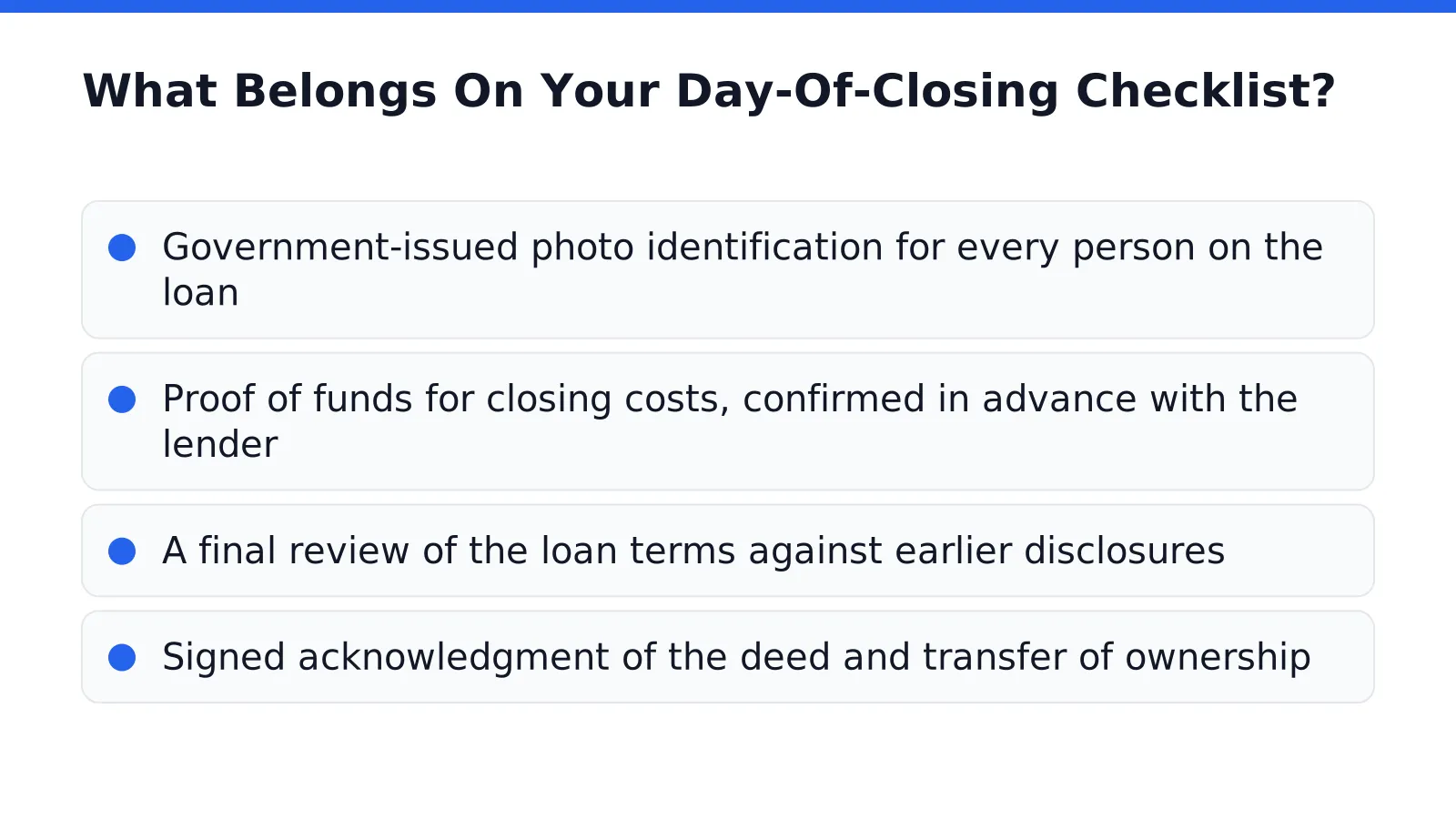
What Belongs On Your Day-Of-Closing Checklist?
A complete day-of-closing checklist centers on three things: proper identification, remaining funds, and final document review. Missing any one of these three items delays the signing and can push the entire transaction to another day.
Buyers preparing for the final signing should treat the closing-checklist as a non-negotiable packing list, not a loose set of reminders. Confirm each item the night before, not the morning of.
What funds need to be brought to closing?
Closing requires the remaining balance due, typically paid through a cashier’s check or a bank wire transfer. The exact amount comes from the final closing disclosure, so buyers should confirm the figure with their lender beforehand. Personal checks and cash are rarely accepted, so cashier’s checks or wires remain the standard. Bringing the wrong payment method stalls the signing and risks losing the scheduled closing slot entirely.
What happens immediately after the documents are signed?
Signing the closing papers is the single moment that transfers ownership. The property passes from seller to buyer the instant the paperwork is finalized, not before. Buyers should treat every signature as final, so questions belong before the pen touches paper, not after.
The core mortgage-closing-steps that round out the day include:
- Government-issued photo identification for every person on the loan
- Proof of funds for closing costs, confirmed in advance with the lender
- A final review of the loan terms against earlier disclosures
- Signed acknowledgment of the deed and transfer of ownership
Munshi Capital’s loan specialists guide borrowers through each of these loan programs, answering day-of-closing questions directly rather than leaving buyers to guess. That borrower-first approach, built on clarity and transparency, supports buyers through the final signatures that make the home official. Buyers weighing their broader financing options, including local programs like those detailed for Mortgage Financing Solutions Walnut Creek, can request a direct cash offer discussion with the lending team before locking in final terms.
What Happens After You Sign Closing Documents?
A pen stroke transfers ownership instantly. Signing finalizes the sale. The property legally passes from seller to buyer the moment all required documents carry a signature. This stage represents the crucial point where every piece of the purchase, financing, title, and paperwork, finally comes together under one transaction.
Buyers who follow a clear closing-checklist-043 before this moment tend to move through signing with confidence rather than confusion. The paperwork itself is routine, but its consequences are not, since each document carries binding financial weight.
Is It Normal to Feel Unsure Right Before Signing?
Hesitation at the closing table happens often, and buyers should not ignore it. If any figure, term, or condition feels wrong, speaking up before finalizing a signature matters more than keeping the appointment on schedule. Trusting that instinct protects buyers from costly surprises that are far harder to undo once documents are recorded.
Once signatures are complete, the keys change hands and the loan enters servicing. This is where sound mortgage-closing-steps-043 planning pays off long after the ink dries. Munshi Capital Inc. built its reputation on transparent, borrower-first guidance, and that commitment does not end at the signing table.
Because the company offers a broad range of residential. Commercial loan programs, from first-time buyer products to investor-focused financing, its role as a reliable partner continues well past the final page of any day-of-closing-checklist-043. Buyers reassessing their property’s value after closing. Planning a future move, can request your property assessment to understand how market conditions affect their next financing decision.
FAQ
What documents do buyers need for closing?
Buyers need a government-issued ID, proof of homeowners insurance, and final bank statements verifying funds for closing costs. Loan officers also confirm employment and income one final time before sending documents to the title company.
When should buyers review the Closing Disclosure?
Buyers review the Closing Disclosure at least three business days before signing day. This review confirms loan terms, interest rates, and final costs match the pre-approval paperwork exactly, preventing last-minute surprises.
How does Munshi Capital support buyers through closing?
Munshi Capital pairs loan specialists with digital tools so borrowers see loan status from pre-approval through the final signature. This transparency helps buyers address discrepancies before they cause delays.
Conclusion
In closing, a comprehensive mortgage closing checklist protects your investment and ensures a seamless transition to homeownership. By systematically verifying documentation, reviewing loan terms, conducting final inspections, and confirming all financial obligations, you eliminate costly oversights and proceed with confidence. The closing process demands precision and clarity, elements that define responsible lending. Your diligence at this critical juncture, paired with transparent guidance from experienced loan specialists, establishes a foundation for successful property ownership and long-term financial stability.
Leave a Reply