
A printable mortgage glossary quick reference guide from Munshi Capital Inc. defines essential terms like FHA, VA, USDA, DSCR, and hard money loans, giving borrowers nationwide clear, downloadable definitions to confidently navigate application, underwriting, and closing without confusion or hidden surprises.
Mortgage terms made clear, including the 28/36 rule, which caps housing expenses at 28% of income and total debt at 36%, plus definitions for ARMs, DSCR loans, FHA, VA, and USDA programs. Munshi Capital Inc. guides borrowers through every term with transparent, borrower-first explanations from pre-approval to closing.
A printable mortgage glossary compiles terms like the 28/36 rule, ARM, and DSCR into one quick-reference sheet for easy review. Munshi Capital Inc. publishes a Glossary of Key Terms covering loan programs, underwriting language, and debt ratios, giving first-time buyers, self-employed borrowers, and investors a dependable tool for decoding mortgage documents before closing.
Key Takeaways
- The 28/36 rule establishes maximum housing expenses at 28% and total debt at 36% of income.
- 5/1 adjustable rate mortgages lock initial rates for 5 years before adjusting annually thereafter.
- Mortgage glossaries define essential terms like abstract of title, 401(k) contributions, and debt-to-income ratios.
- Understanding key mortgage terminology empowers borrowers to navigate financing options with confidence and clarity.
Why Do You Need A Mortgage Cheat Sheet?
A mortgage cheat sheet solves a basic problem: unfamiliar terms slow down loan decisions. First-time buyers, self-employed applicants, and investors all face the same wall of industry language before they ever compare rates. Munshi Capital Inc. serves this exact range of borrowers, from first-time homebuyers to seasoned investors, each needing clear terminology to weigh one loan option against another.
Confusing jargon costs borrowers more than time. A mission built on transparency replaces that confusion with plain explanations. Clients understand exactly what they’re signing before they sign it. Hidden surprises during underwriting usually trace back to terms nobody explained at the start.
What Belongs On A Mortgage Cheat Sheet?
A useful reference pairs plain-language definitions with the stages of a loan. Keeping a loan terms printable on hand turns a dense application packet into something scannable during a phone call with a lender.
- Key terms tied to qualification (income documentation, debt ratios)
- Terms specific to the loan type under consideration
- A simple map of the application, underwriting, and closing sequence
Does A Printable Glossary Actually Help During Closing?
Yes. A glossary printable gives borrowers something to check against loan disclosures in real time, rather than guessing. Because the closing sequence moves through defined steps with no hidden surprises, matching each document to a known term catches errors before they become costly delays.

What Are The Core Mortgage Terms To Know?
Five terms form the foundation of any mortgage decision: the 28/36 rule, amortization, the amortization schedule, the 5/1 ARM, and the ability-to-repay rule. Mastering these definitions prevents costly misunderstandings during underwriting and loan comparison. A reliable glossary printable keeps these definitions on hand for quick reference throughout the homebuying process.
Lenders lean heavily on the 28/36 rule to judge affordability. This guideline caps housing expenses at 28 percent of gross income. Limits total debt payments to 36 percent of income. Borrowers who exceed these thresholds often face loan denial or reduced approval amounts, regardless of credit history.
Amortization describes how mortgage debt shrinks over time. Each scheduled payment chips away at the loan balance across the full term, blending principal and interest into one predictable amount. The related amortization schedule lays out every payment date alongside the remaining balance after each one applies, giving borrowers a clear timetable from closing to payoff.
What Is A 5/1 ARM?
A 5/1 adjustable-rate mortgage locks the interest rate for five years before adjustments begin. After that fixed period ends, the rate shifts according to the loan terms, typically once per year. Borrowers planning to sell or refinance within five years sometimes favor this structure for its lower initial rate.
What Does The Ability-To-Repay Rule Require?
Lenders must make a reasonable, good faith determination that a borrower can actually repay the loan. This rule protects applicants from loans structured beyond their financial capacity. Failing to understand it leaves borrowers vulnerable to unsuitable loan terms they cannot sustain long term.
A practical mortgage cheat sheet pairs these five definitions with real examples. A dedicated loan terms printable helps first-time buyers, self-employed applicants, and investors compare offers without missing hidden obligations buried in contract language.
Which Loan Programs Fit Buyers And Investors?
Loan fit depends on income structure and property goals, not credit score alone. Munshi Capital Inc. builds its programs around four borrower types: traditional W-2 buyers, self-employed earners, residential investors, and larger commercial operators. Matching the right structure to the right borrower prevents wasted applications and unnecessary rate markups.
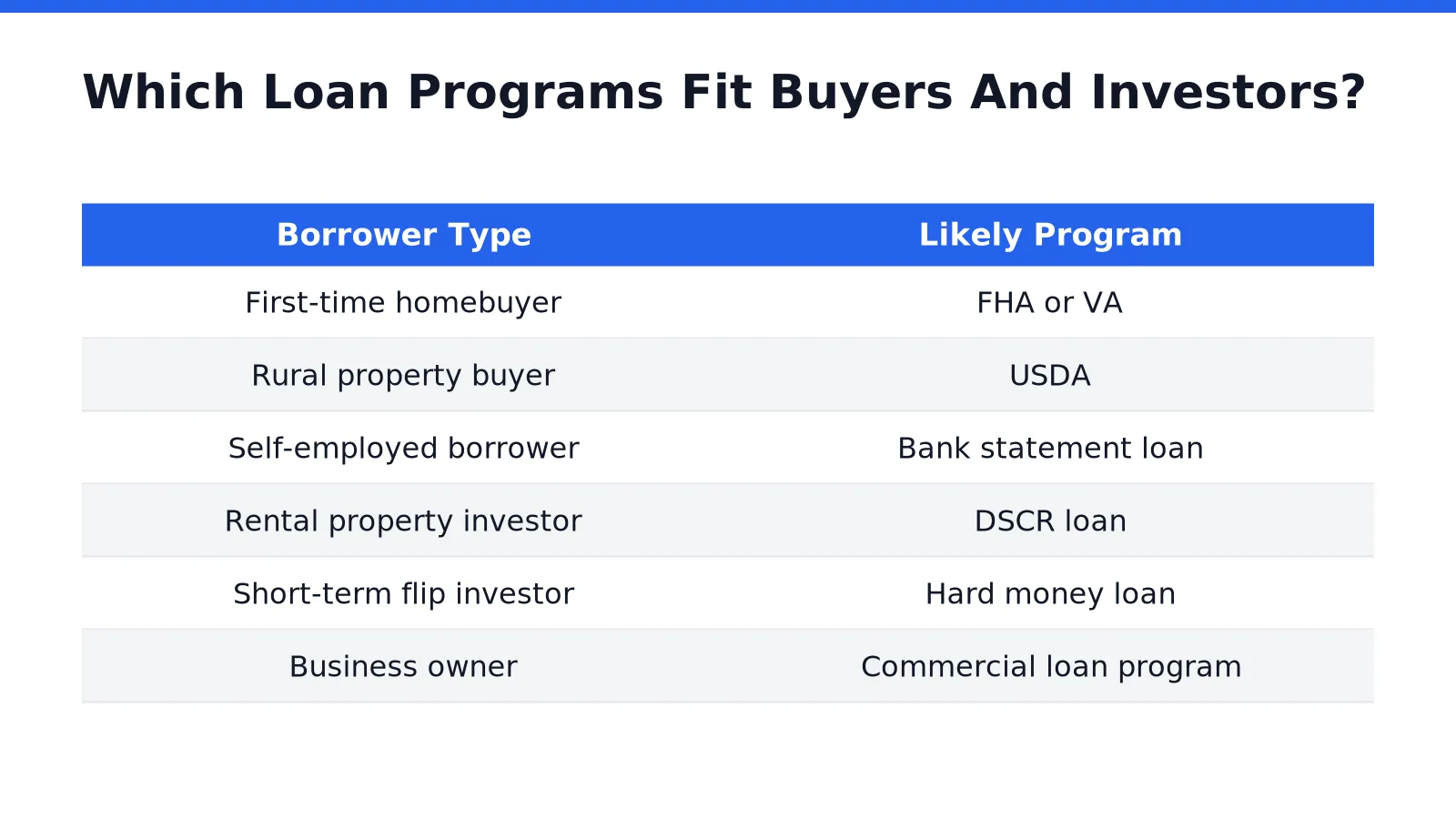
For buyers purchasing a primary residence, FHA, VA, USDA, and bank statement loans cover most scenarios. FHA and VA programs suit buyers with limited down payments or military service history. USDA loans apply to eligible rural and suburban properties. Bank statement loans serve self-employed borrowers whose tax returns understate true cash flow, a common hurdle for freelancers and small business owners.
What loan works best for real estate investors?
Investors generally need financing judged on the property’s income, not personal payroll. DSCR and hard money loans fill that role directly. DSCR, or debt service coverage ratio, financing qualifies borrowers based on the rental income a property generates relative to its debt obligations. Hard money loans move faster and fit short-term situations like fix-and-flip projects or competitive bidding on investment properties.
Does Munshi Capital serve business owners too?
Yes. The company’s loan range spans both residential and commercial programs, serving homebuyers, investors, and business owners across the country. Commercial borrowers get financing structures separate from standard residential underwriting, reflecting different risk profiles and repayment timelines.
A quick comparison clarifies the fit:
One more term worth knowing: an adjustable rate mortgage carries an interest rate that can change over time, typically tied to a benchmark index. That structure matters when comparing long-term holding costs against fixed-rate options, especially for investors weighing multiple properties at once.

How Does The Application-To-Closing Process Actually Work?
Munshi Capital Inc. moves borrowers from application to closing through a sequence built on clarity rather than confusion. Loan specialists guide each client step by step, stripping out the jargon that typically clouds mortgage transactions. No surprise conditions appear late in the process. That structure matters most for first-time buyers and self-employed borrowers, who often face denser documentation requirements than a standard W-2 applicant.
The process starts small: a short, secure application. Borrowers share their financial goals directly with a loan specialist. Indicate whether a residential or commercial program fits their situation. From there, technology and human judgment work together. Modern underwriting systems speed up document review, while a dedicated specialist interprets results and answers questions the software cannot.
That combination produces two tangible benefits for borrowers:
- Quick pre-approvals, so buyers can move on competitive listings with confidence
- Full visibility into loan status, from the initial application through final closing documents
What Happens Between Pre-Approval And Closing?
Between pre-approval and closing, specialists verify income, assets, and property details while keeping borrowers informed at each checkpoint. Investors and self-employed applicants often benefit from reviewing a mortgage cheat sheet alongside their file. Program terminology varies across FHA, DSCR, and bank statement loans. Having a loan terms printable on hand reduces back-and-forth questions during underwriting.
Why Does Transparency Matter More For Self-Employed Borrowers?
Self-employed borrowers face more documentation scrutiny, since income verification lacks the simplicity of a standard pay stub. A glossary printable helps these applicants recognize terms like debt-to-income ratio or amortization before they appear in closing paperwork. Clarity at each stage prevents last-minute confusion that can delay funding.
How Should You Use This Glossary Going Forward?
Ongoing reference turns confusing paperwork into clear decisions. Borrowers who revisit mortgage terminology before each major step avoid costly misunderstandings at the negotiating table. A saved glossary printable works best when paired with real application documents, not read once and forgotten.
Treat the definitions here as a working mortgage cheat sheet for every stage of the loan process. Checking terms before signing disclosures, comparing rate options, or reviewing closing documents keeps expectations grounded in fact rather than assumption. Clarity at each stage prevents surprises later, especially for self-employed borrowers navigating income documentation or investors comparing financing structures.
Should Borrowers Print or Save a Digital Copy?
Either format works, provided the glossary stays accessible during active loan shopping. A loan terms printable version suits borrowers who want notes beside them during lender calls. Investors managing multiple properties may prefer a digital file they can search quickly by keyword.
What Should Borrowers Do With Unfamiliar Terms?
Flagging unclear terms before signing anything prevents confusion down the line. For example, understanding that an additional principal payment reduces the remaining balance and shortens the loan term helps borrowers evaluate payoff strategies with confidence. Munshi Capital Inc. offers personalized guidance nationwide, with loan specialists dedicated to understanding each borrower’s goals. That combination of integrity and individualized service has made the company a trusted resource for homebuyers and investors across the country.
FAQ
What is a printable mortgage glossary?
A printable mortgage glossary compiles terms like the 28/36 rule, ARM, and DSCR into one quick-reference sheet, helping borrowers decode loan documents before closing with Munshi Capital Inc.’s transparent guidance.
Why do borrowers need a mortgage cheat sheet?
Unfamiliar terms slow down loan decisions for first-time buyers, self-employed applicants, and investors alike. A mission built on transparency replaces that confusion with plain explanations before signing.
Does a glossary printable help during the closing process?
Yes, it gives borrowers something to check against loan disclosures in real time, matching each document to a known term to catch errors before they become costly delays.
Conclusion
In closing, a comprehensive mortgage glossary serves as an essential reference tool for navigating the complexities of the lending landscape with confidence and clarity. By familiarizing yourself with these fundamental terms and concepts, you establish a foundation for informed decision-making throughout your financing journey. Whether you are a first-time homebuyer or an experienced investor, understanding mortgage terminology empowers you to engage meaningfully with loan specialists, evaluate your options objectively, and secure financing that aligns with your specific financial objectives. Armed with this knowledge, you are positioned to approach your mortgage process with transparency and assurance.
Leave a Reply