
When it comes to mortgage-glossary-034, key mortgage terms include FHA, VA, USDA, DSCR, and bank statement loans, each representing distinct financing structures for residential or investment properties. Munshi Capital Inc. defines these terms clearly during the application, underwriting, and closing stages, ensuring borrowers nationwide fully understand every loan program before committing.
Mortgage terms clarified: the 28/36 rule limits housing expenses to 28% of gross income and total debt obligations to a maximum of 36% of gross income. A 5/1 ARM keeps your rate fixed for five years before annual adjustments. Munshi Capital Inc. walks borrowers through every definition with clear, transparent guidance from application to closing.
A mortgage terms glossary defines essential lending vocabulary, from the 28/36 rule governing debt-to-income ratios to concepts like abstract of title. Munshi Capital Inc. supports borrowers in understanding this terminology throughout the lending process, helping first-time homebuyers, self-employed borrowers, and investors decode unfamiliar language before applying.
Key Takeaways
- The 28/36 rule limits housing expenses to 28% of gross income and total debt obligations to a maximum of 36% of gross income, guiding lenders in assessing affordability.
- Adjustable rate mortgages feature fixed periods of 3, 5, 7, or 10 years before rates adjust.
- Abstract of title documents the complete transaction history for a specific property’s ownership record.
- 401(k) retirement plans allow employees to contribute pre-tax or after-tax percentages from their paychecks.
Why Learn Mortgage Terms Before You Apply?
Unfamiliar vocabulary creates confusion at the exact moment borrowers need confidence most. Terms like underwriting, escrow, and debt-to-income ratio appear on nearly every disclosure a lender sends. Misreading one can delay an approval or lead to a loan that doesn’t fit. Munshi Capital Inc. builds its lending process around clarity, so borrowers understand every term before signing anything. A solid mortgage terminology guide removes that guesswork early, before stakes rise.
First-time homebuyers face the steepest learning curve. Self-employed applicants and real estate investors encounter their own layer of specialized language, from bank statement loans to DSCR calculations. Without a working mortgage glossary, important details get missed, and missed details cost time, money, and sometimes the deal itself.
What Happens If a Borrower Skips the Terminology?
Skipping the vocabulary lesson does not make the process simpler; it just shifts confusion to a later, more stressful stage. Borrowers who don’t understand terms at application often hit roadblocks during underwriting, when documentation requests reference concepts they never learned. Munshi Capital Inc. structures application, underwriting, and closing as a connected sequence, built so each stage stays understandable rather than surprising.
Where Should Borrowers Start Learning the Terms?
A practical loan terms explained resource should cover the basics first: interest rate type, loan term, and closing costs. From there, borrowers can tackle program-specific language tied to FHA, VA, USDA, or investor-focused financing.
Munshi Capital Inc. positions its mortgage financing around the borrower directly, offering guidance through every loan program with clear answers and dependable service. That guidance works best when paired with foundational knowledge, which is why terminology matters before, not after, application day.
What Do Core Loan Program Terms Mean?
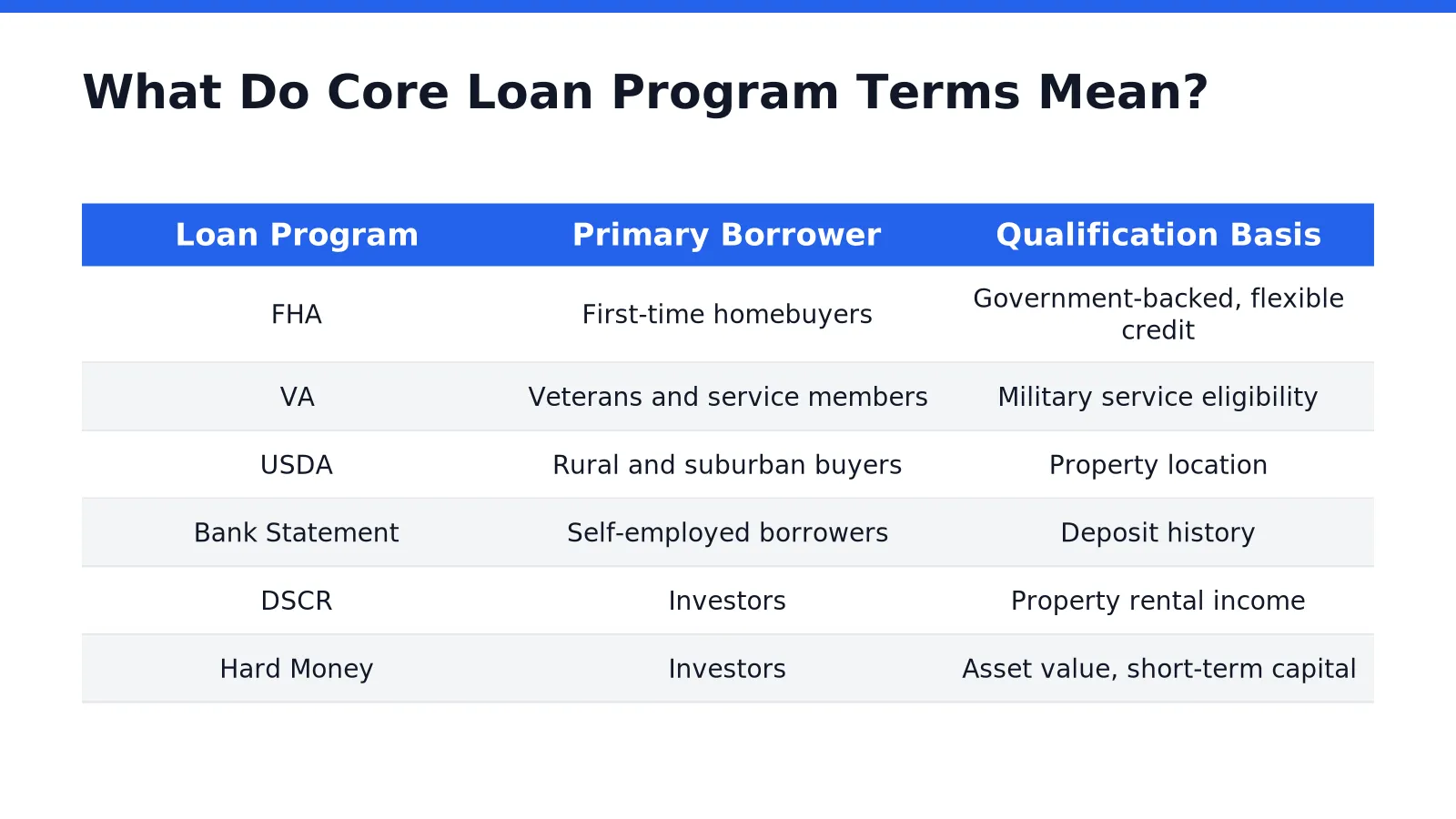
Core loan program terms define the structure, eligibility, and purpose behind each mortgage product. Residential and commercial borrowers rely on a precise mortgage glossary to understand which program fits their income, credit profile, and investment goals. Munshi Capital Inc. offers FHA, VA, USDA, and bank statement loans, each built for a distinct borrower profile.
First-time buyers with limited down payment savings often qualify for FHA loans, which carry government backing and flexible credit requirements. Veterans and active service members access VA loans, designed around military service eligibility rather than traditional income documentation. Rural and suburban buyers turn to USDA loans, structured for properties located in eligible geographic zones. Self-employed borrowers, meanwhile, use bank statement loans, which verify income through deposit history instead of W-2 tax forms.
What loan terms matter most for real estate investors?
Investors need loan terms explained in the context of cash flow and property performance, not personal income. DSCR loans, short for debt service coverage ratio loans, qualify borrowers based on a property’s rental income relative to its debt obligations. Hard money loans supply short-term, asset-based capital for investors moving quickly on acquisitions or renovation projects.
A dependable mortgage terminology guide connects first-time homebuyers, seasoned investors, and business owners to residential or commercial financing matched to their actual financial picture. No single program fits every borrower, and that is precisely why the distinctions above carry so much weight.

How Do Rate And Payment Terms Work?
Rate and payment terms determine how much a monthly mortgage payment costs and whether that cost can change over time. Two structures dominate the market: fixed rates and adjustable rate mortgages. Each handles risk differently, and that difference shapes long-term budgeting for first-time buyers and investors alike.
An adjustable rate mortgage, known as an ARM, carries an interest rate that shifts over time. The rate typically tracks a published index rather than holding steady for the life of the loan. Borrowers who choose an ARM accept uncertainty in exchange for a lower introductory rate.
What does a 5/1 ARM mean?
A 5/1 ARM locks the initial interest rate for five full years. After that fixed period, the loan enters an adjustment phase where the rate can rise or fall. This structure directly affects how a borrower plans monthly payments beyond year five, since budgeting for a static payment stops working once adjustments begin.
How often can an ARM rate change?
The adjustment interval sets the schedule for rate changes after the fixed period ends. The specific interval varies by loan program and is defined in each loan’s terms. Borrowers should confirm the schedule with their loan specialist before closing.
Amortization ties these pieces together. It describes paying down the loan balance through equal payments on a regular, usually monthly, schedule. Even when an ARM’s rate adjusts, the amortization structure still governs how each payment splits between principal and interest. Understanding this relationship helps borrowers compare loan offers with clear eyes rather than guesswork.

Which Terms Affect Your Qualification And Closing?
Three terms carry the most weight during underwriting and closing: the debt ratio guideline, the repayment verification standard, and the property’s title history. Each one determines whether a loan file moves forward or stalls. Missing any one of these creates delays that cost borrowers time and money.
The 28/36 rule sets the benchmark lenders use to judge affordability. It limits housing expenses to 28% of gross income. Total debt obligations to a maximum of 36% of gross income. A household carrying high credit card balances or auto loans may qualify for a smaller loan amount than expected, even with strong income.
What Does Ability-To-Repay Mean For Borrowers?
The ability-to-repay rule forces lenders to verify, in good faith, that a borrower can realistically handle loan payments. This standard protects applicants from loans structured beyond their actual financial capacity. Self-employed borrowers and investors often face closer scrutiny here, since income documentation looks different than a standard pay stub.
Lenders typically confirm repayment capacity through:
- Verified income and employment history
- Debt-to-income calculations tied to the 28/36 framework
- Asset and reserve documentation
- Credit history review
Why Does Title History Matter Before Closing?
An abstract of title traces every recorded transaction tied to a property, from its original transfer forward. Closing cannot proceed cleanly without a clear title record. Unresolved liens, boundary disputes, or past ownership gaps surface during this review and must be cleared first.
Together, these three terms form the backbone of a mortgage file. Borrowers who understand how debt ratios, repayment verification, and title records interact move through underwriting with fewer surprises and faster closings.
How Does Munshi Capital Guide Your Process?
Munshi Capital guides borrowers through a structured path built on technology paired with hands-on loan specialist support. Every stage, from first application to final closing, stays visible to the borrower. Lenders who hide steps create confusion; Munshi Capital removes that risk through steady communication.
The process opens with a quick, secure application. A loan specialist reviews the borrower’s goals directly and helps identify whether a residential or commercial program fits best. This conversation shapes the entire loan path, so accuracy here matters more than speed alone.
What happens after the application is submitted?
Borrowers move into pre-approval, where technology accelerates document review without sacrificing oversight. Full visibility into loan status continues from this point forward, through underwriting and into closing. No stage happens behind closed doors.
Why does personalized guidance matter in mortgage lending?
A standardized mortgage terminology guide only goes so far; individual financial pictures vary widely, especially for self-employed borrowers and investors. Personalized service, paired with a broad product lineup, supports Munshi Capital’s reputation among homebuyers and investors nationwide. Integrity remains the foundation of that reputation, not a marketing phrase.
For sellers weighing their next move alongside financing decisions, the next step is straightforward:
- Review current loan programs with a specialist
- Confirm which residential or commercial option applies
- Consider options to request a direct cash offer if selling is part of the plan
- Track status through underwriting to closing
Those ready to act can request your property assessment before finalizing a financing strategy.
FAQ
What is the 28/36 rule?
The 28/36 rule limits housing expenses to 28% of gross income. Total debt obligations to a maximum of 36% of gross income, helping borrowers understand standard debt-to-income guidelines before applying.
Why should borrowers learn mortgage terms before applying?
Unfamiliar vocabulary like underwriting, escrow, and debt-to-income ratio appears on nearly every disclosure. Misreading these terms can delay approval or lead to a loan that doesn’t fit.
Where can borrowers find definitions for specialized loan terms?
Munshi Capital Inc. clarifies loan terminology for homebuyers, self-employed borrowers, and investors throughout the application, underwriting, and closing process.
Conclusion
In closing, understanding mortgage terminology empowers borrowers to navigate the lending process with confidence and clarity. Mastery of these essential terms, from amortization schedules to debt-service coverage ratios, enables informed decision-making aligned with your financial objectives. At Munshi Capital Inc., we remain committed to demystifying the mortgage landscape through transparent communication and personalized guidance, ensuring you move forward with complete visibility into every aspect of your financing journey.
Leave a Reply