
Homebuyer milestones follow a clear sequence: check credit, get pre-approved, hire a REALTOR®, search listings, submit an offer, complete inspection, finalize the loan through underwriting, order a home appraisal, and close. Munshi Capital Inc. guides first-time buyers, move-up buyers, and investors through FHA, VA, USDA, and bank statement loan programs at each stage.
Key Takeaways
- Get your finances in order first, review credit scores, savings, and debt before starting your homebuying journey.
- Down payment requirements vary; many loan programs require less than 20% down for qualified borrowers.
- Lenders arrange home appraisals to verify property value and ensure loan amounts align with actual worth.
- Budget for closing costs and prepaids including appraisals, inspections, and other essential homebuying expenses upfront.
What should you do before starting your home search?
Financial preparation comes first, months before a single property tour. Buyers who skip this step risk falling for a house they cannot finance, wasting time on applications that stall, or losing negotiating leverage at the offer stage. Building a solid homebuyer checklist at this early stage prevents those costly surprises later.
Several factors deserve review well in advance of browsing listings:
- Review income stability. Lenders look for consistent, verifiable earnings before approving any loan amount.
- Check credit standing. Lenders set a minimum credit score requirement to qualify for a home loan. Higher scores unlock better terms and lower interest rates.
- Calculate available savings. Funds need to cover a down payment plus reserves for unexpected costs.
- Assess existing debt. Lower debt loads improve approval odds and loan terms alike.
These four homebuying steps form the foundation of the full process, and skipping any one of them creates friction down the line.
What credit score is needed to buy a house?
Meeting a lender’s minimum credit score requirement qualifies a borrower for a home loan. Scores above that threshold typically translate into more favorable interest rates and repayment terms. Borrowers with lower scores still have options, but the loan terms become less competitive.
Munshi Capital Inc. serves a broad spectrum of borrowers, from first-time buyers checking their credit for the first time to seasoned investors managing multiple properties. Guidance runs through every loan program, with clear answers built around each borrower’s specific goals rather than a one-size-fits-all script. Sellers weighing a faster path can also request a direct cash offer instead of waiting through a lengthy traditional sale timeline.

How do you organize your finances and documents?
Organized finances start with a clear system, not a stack of paper on a kitchen counter. Buyers who sort income records, bank statements, and debt information early move through underwriting with fewer delays. A disciplined approach here shapes every later stage of the homebuying steps, from pre-approval to closing day.
A common misconception is that a 20% down payment is mandatory. However, many loan programs allow for lower down payments for qualified borrowers. Funds still need to be set aside, however, for closing costs and prepaid expenses such as appraisals and inspections. Skipping this planning step leaves buyers scrambling for cash at the worst possible moment, right before closing.
How much cash should a buyer set aside beyond the down payment?
Beyond the down payment itself, buyers need reserves for closing costs, appraisal fees, and inspection charges. These prepaid costs catch many buyers off guard because they fall outside the advertised purchase price. Building this cushion into a budget early prevents last-minute financing gaps.
A thorough document checklist keeps the process moving and limits back-and-forth with underwriters. Core categories include:
- Proof of income, such as pay stubs and tax returns
- Bank statements covering recent months
- Records of existing debts and monthly obligations
- Identification and residency documentation
Following a structured homebuyer checklist for financial preparation reduces the risk of surprises later. Munshi Capital Inc. builds its lending process around clarity and honest communication at every stage, guiding borrowers from first-time buyers to experienced investors through application, underwriting, and closing without hidden surprises. Buyers ready to move forward can request a direct cash offer. Those still weighing their options can request your property assessment to understand where they stand before applying.
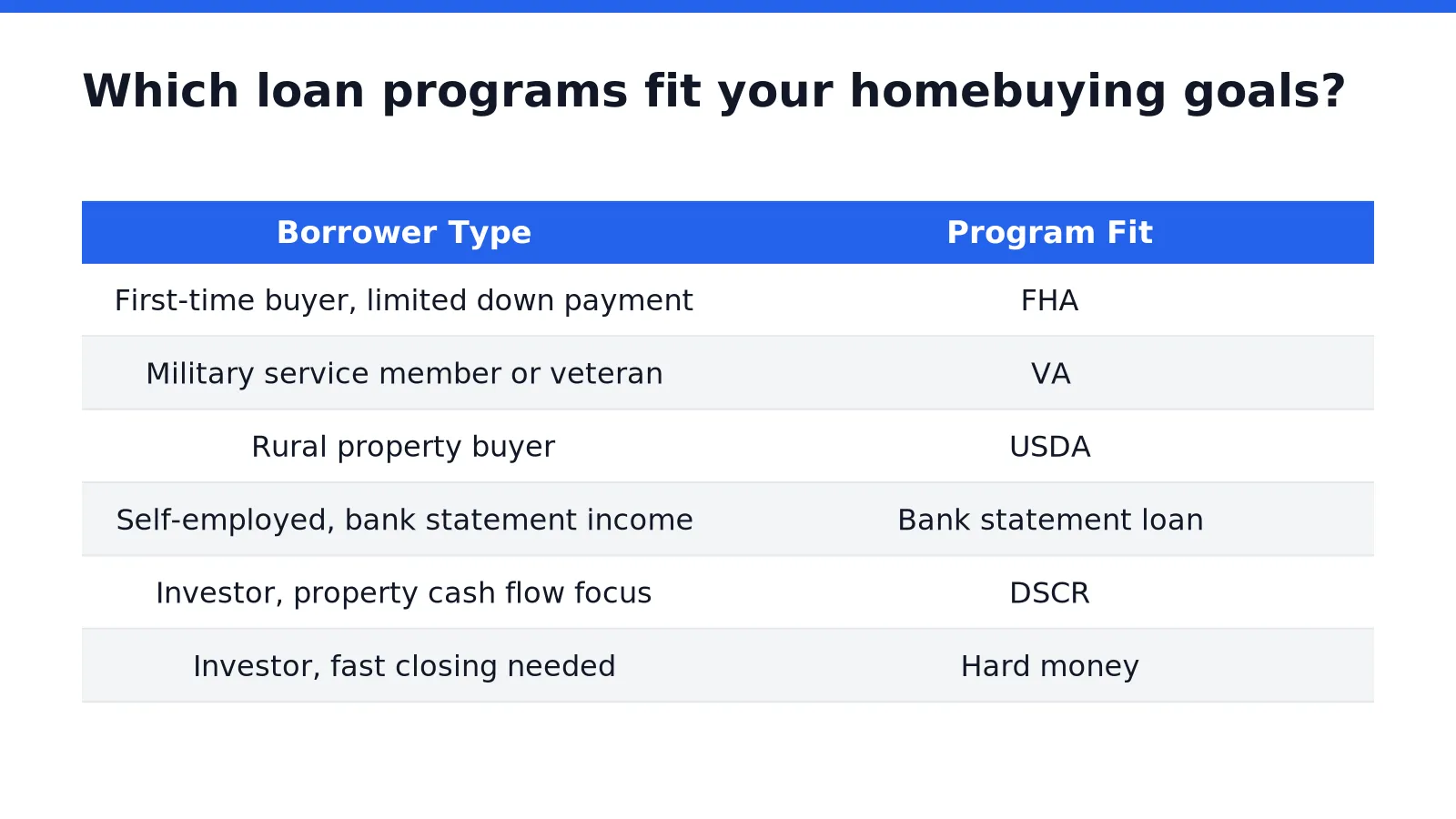
Which loan programs fit your homebuying goals?
Loan selection depends on income structure, credit profile, and investment intent. Munshi Capital Inc. matches each client to a program built around their specific financial picture rather than a one-size-fits-all product. First-time buyers, move-up buyers, and investors each face different qualifying hurdles. The right program closes those gaps instead of creating new ones.
Munshi Capital Inc. offers a comprehensive suite of residential and commercial programs, including FHA, VA, USDA, and bank statement loans. Self-employed borrowers who lack traditional pay stubs often qualify through bank statement review instead of tax returns alone. Investors seeking cash flow-based qualification turn to DSCR loans. Those needing speed on a competitive property use hard money financing. These specialized products extend Munshi Capital Inc.’s investor-focused lineup beyond conventional residential lending.
How does a loan specialist determine the right program?
A specialist reviews income documentation, credit history, and the property type before recommending a program. This review forms the foundation of the broader document checklist required later in underwriting. Matching the program early reduces delays further into the homebuying steps that follow.
Technology and hands-on guidance work together throughout this process. Modern systems deliver quick pre-approvals, while loan specialists maintain full visibility into status updates from application through closing. That combination keeps every stage of the homebuyer checklist transparent and prevents last-minute surprises.
What steps take you from offer to closing?
Five distinct milestones separate an accepted offer from a signed deed: appraisal, underwriting review, document collection, loan approval, and final walkthrough. Buyers who skip or delay any one of these steps risk losing their closing date, or worse, losing financing altogether. A clear homebuying checklist keeps each milestone on schedule and prevents last-minute surprises.
The appraisal stage carries the most financial weight. While the loan moves through finalization, the lender arranges a home appraisal to confirm the property’s value matches the agreed price. Lenders will not approve financing above the appraised value, regardless of what the contract states. If the appraisal comes in low, buyers gain leverage to renegotiate the purchase price with the seller.
What happens if the appraisal is lower than the offer price?
A low appraisal creates a gap between what the lender will finance and what the buyer agreed to pay. Buyers can ask sellers to lower the price to match the appraisal, cover the difference in cash, or walk away under contract contingencies. Without resolution, the loan will not move forward.
Munshi Capital guides borrowers through each of these homebuying steps, from the initial application through the closing table, with clear communication and no hidden surprises at any stage. Document readiness drives the pace of underwriting more than any other factor.
A thorough document checklist typically includes:
- Income verification (pay stubs, tax returns, W-2s)
- Bank statements covering recent months
- Credit history and debt documentation
- Signed purchase agreement and disclosures
Borrowers nationwide, from first-time buyers to seasoned investors, receive personalized guidance designed to match their specific financial picture and move financing forward with confidence.
What mistakes should you avoid along the way?
Skipping agent research ranks among the costliest errors in the homebuying steps. Buyers lose negotiating leverage and local market insight when they hire the first agent they meet. Friends, family, and coworkers offer a practical starting point for referrals. Prospective buyers should plan to interview several candidates before committing to one.
Misunderstanding commission structure causes confusion at the negotiating table. Each real estate brokerage sets its own commission rates individually; no law or regulatory body fixes these figures. Buyers who assume a standard rate across every brokerage risk being caught off guard during contract discussions.
Why does choosing the wrong lender create problems later?
A mismatched lender slows approvals and muddies communication at the worst possible moment, right before closing. Munshi Capital Inc. was built on trust and stands committed to transparent, borrower-first mortgage guidance, with clarity and honesty driving every client interaction. That borrower-first ethos reduces the risk of last-minute surprises that derail a purchase.
Buyers planning a homebuyer checklist should avoid these common missteps:
- Choosing a lender or agent without comparing options
- Overlooking how commission rates vary by brokerage
- Assuming every lender offers the same loan programs
Munshi Capital Inc.’s wide array of loan products, spanning first-time buyer programs through investor financing, makes the company a trusted nationwide choice for borrowers who want to avoid these pitfalls.
FAQ
What is the step-by-step order of the homebuyer checklist?
Buyers check credit, get pre-approved, hire a REALTOR®, search listings, submit an offer, complete inspection, finalize the loan through underwriting, order a home appraisal, and close. Munshi Capital Inc. guides first-time buyers, move-up buyers, and investors through each stage.
Does buying a home require a 20% down payment?
A 20% down payment is not mandatory. Many low down payment loan programs exist for qualified borrowers. Funds still need to cover closing costs and prepaid expenses like appraisals and inspections.
What finances should buyers organize before starting their home search?
Buyers review income stability, check credit standing, calculate available savings, and assess existing debt. Sorting income records, bank statements, and debt information early reduces delays during underwriting and closing.
Conclusion
In closing, navigating the homebuyer checklist requires methodical attention to financial preparation, property evaluation, and financing strategy. By systematizing each step, from credit assessment through final closing, you establish a foundation for confident decision-making. Munshi Capital Inc. stands ready to guide you through the financing component with transparent communication and personalized loan solutions tailored to your specific circumstances. Our commitment to clarity throughout the application, underwriting, and closing process ensures you maintain full visibility and understanding at every stage, transforming what can be a complex transaction into a straightforward path toward homeownership.
Leave a Reply