
Borrowers at Munshi Capital Inc. start with pre-approval, then submit documentation for FHA, VA, USDA, or bank statement loans, proceed through underwriting, and finish at closing, a transparent, four-step process backed by modern technology and dedicated loan specialists guiding you nationwide.
Loan programs such as FHA, VA, USDA, bank statement, DSCR, and hard money options form the foundation at Munshi Capital Inc., where applying begins with a straightforward application, moves through underwriting, and finishes at closing. Pre-approval comes quickly, full loan-status visibility stays available through
Mortgage applications require core steps, including checking credit, setting a budget, and gathering income and asset documents. Borrowers also choose a lender, submit an application, and lock rates. Munshi Capital Inc. guides first-time buyers, self-employed borrowers, and investors through FHA, VA, USDA, DSCR, and bank statement programs, matching each financial profile to the right loan.
Key Takeaways
- Gather financial documents and determine your budget before beginning the mortgage application process with Munshi Capital.
- Complete our straightforward application online, by phone, or in person with transparent guidance from our loan specialists.
- Receive quick pre-approval and maintain full visibility into your loan status throughout underwriting and closing phases.
- Choose from FHA, VA, USDA, bank statement, DSCR, and hard money loan programs tailored to your financial situation.
What Should You Prepare Before Applying?
Preparation before applying centers on two tasks: setting a target home price and reviewing credit history for errors. Borrowers who skip either step risk denied applications, inflated interest costs, or offers built on unrealistic budgets. A structured approach, the kind found in thorough mortgage how-to guides, removes much of that risk before the first form gets signed.
Before starting any of the steps below, borrowers need a clear picture of monthly income, savings, and existing debt obligations. That baseline makes each step accurate rather than guesswork.
- Calculate a realistic target home price using current income, savings, and monthly budget constraints.
- Pull credit reports from the major bureaus well ahead of applying.
- Review each report line by line and flag any inaccurate entries.
- Correct confirmed errors promptly, since unresolved mistakes slow down underwriting later.
These actions form the backbone of most step-by-step mortgage tutorials. For good reason: lenders evaluate both affordability and credit history before issuing any approval.
How does Munshi Capital help borrowers prepare faster?
Munshi Capital Inc. pairs modern technology with hands-on loan specialist service to move the preparation phase along quickly. That combination gives borrowers rapid pre-approvals and full visibility into loan status from the very first step. First-time buyers, self-employed applicants, and investors all benefit from that transparency, since confusion about document requirements causes most early delays.
What belongs in a home loan preparation checklist?
A solid preparation checklist includes a defined price target, verified credit reports, and corrected errors, in that order. Following structured home loan tutorials during this phase keeps the later application and underwriting stages shorter and far less stressful.
How Do You Choose A Lender And Loan Program?
Choosing a lender and a loan program starts with matching a borrower’s financial profile, income type, and property goal to one of several available structures. Munshi Capital Inc. serves a wide range of clients, from first-time buyers purchasing their first home to seasoned investors expanding a rental portfolio. That range matters because no single loan structure fits every income type or property goal.
Selecting a lender is the step that comes before completing a formal application, not after. Borrowers who skip this comparison often lock into terms that don’t match their documentation or long-term plans. The loan suite includes FHA, VA, USDA, and bank statement loans, each built for a different financial picture:
- FHA and VA loans: suited to buyers seeking lower down payment thresholds or military-connected benefits.
- USDA loans: designed for eligible rural and suburban property purchases.
- Bank statement loans: built for self-employed borrowers whose tax returns don’t reflect full earning capacity.
- DSCR and hard money loans: structured for investors financing rental or short-term acquisition deals.
Which loan program fits a self-employed borrower?
Self-employed applicants often carry income that tax filings understate. Bank statement loans solve this by qualifying borrowers on deposit history rather than net taxable income.
How should a first-time buyer compare lenders?
First-time buyers should request documentation checklists and rate comparisons before signing anything. Many rely on mortgage how-to guides and step-by-step mortgage tutorials, alongside home loan tutorials, to understand terminology before meeting a loan officer.
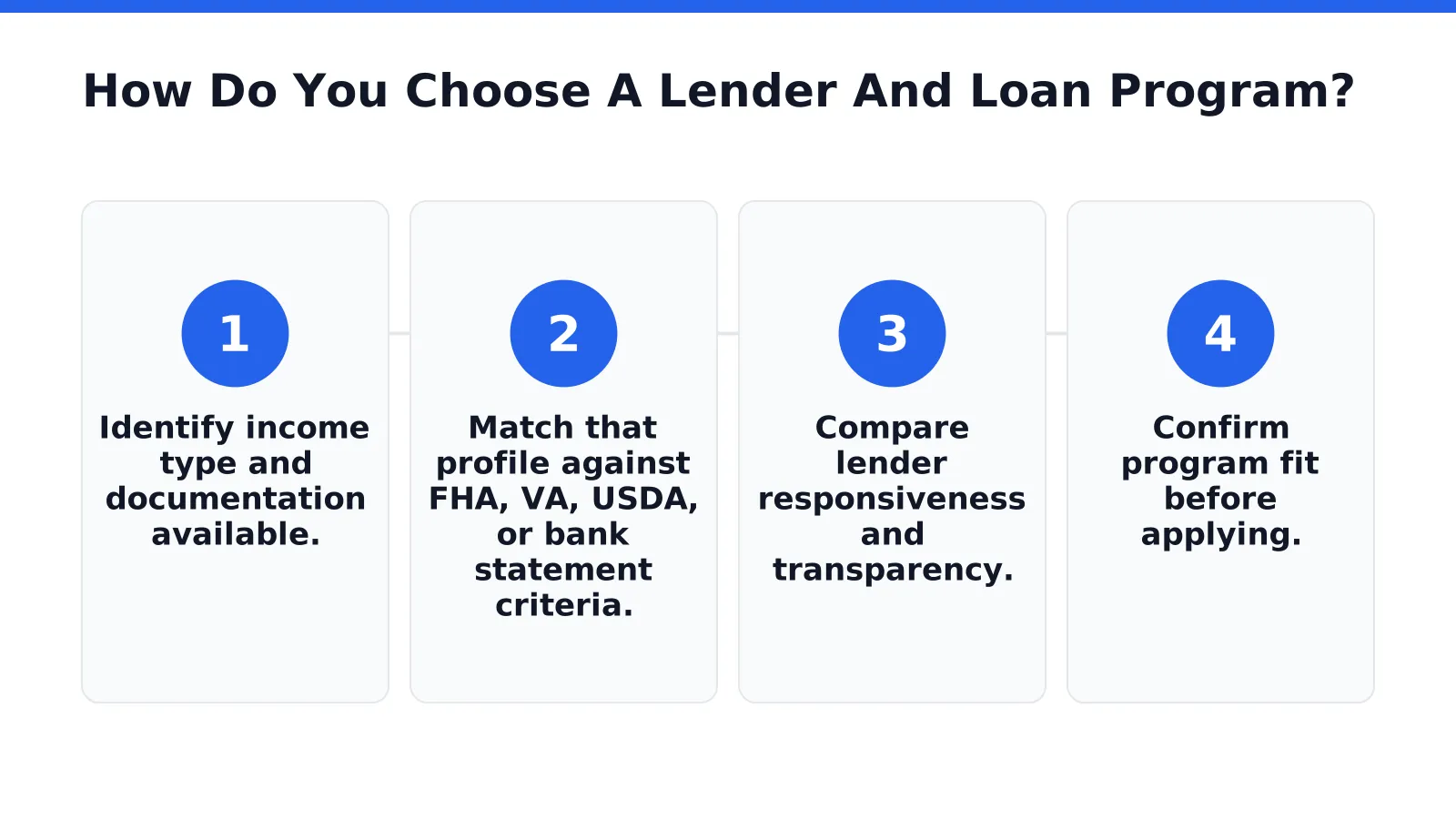
- Identify income type and documentation available.
- Match that profile against FHA, VA, USDA, or bank statement criteria.
- Compare lender responsiveness and transparency.
- Confirm program fit before applying.
Investors ready to sell a property instead of financing one can request a direct cash offer. Owners weighing their options can request your property assessment first.

What Documents Does Your Application Require?
Mortgage applications require proof of employment history, creditworthiness, and overall financial standing. Lenders verify this information for every borrower and, when applicable, every co-borrower listed on the loan. Missing paperwork stalls a file at the first checkpoint, pushing closing dates back and frustrating sellers who expect a clean timeline.
First-time homebuyers, self-employed borrowers, and investors each face slightly different documentation demands, but a core set applies broadly. Most applicants need two years of W-2 forms, a standard requirement lenders use to confirm steady earnings. Beyond income verification, files typically include:
- Government-issued identification for each borrower and co-borrower
- Recent pay stubs or profit-and-loss statements for self-employed applicants
- Bank statements showing asset reserves and deposit history
- Two years of tax returns, particularly for investors with multiple income streams
- Credit authorization forms allowing the lender to review payment history
What happens after the paperwork is submitted?
Munshi Capital’s process starts with a quick, secure online submission rather than a stack of mailed forms. Applicants then connect directly with a Munshi Capital loan specialist to discuss their goals. That conversation determines which residential or commercial program fits the borrower’s financial picture, from standard conventional loans to specialized investor products.
Why does documentation differ for self-employed borrowers?
Self-employed income lacks the steady W-2 trail traditional lenders rely on. Underwriters instead examine business statements and tax filings to establish a reliable income pattern over time.
These guidelines reflect current mortgage how-to guides. step-by-step mortgage tutorials, giving every borrower profile a clear path through the paperwork stage. Treating documentation as the foundation of the broader home loan tutorials process keeps the remaining steps moving without delay.
What Happens During Underwriting And Processing?
Underwriting functions as a distinct, formally recognized stage of the mortgage process, separate from application and closing. A loan file moves from processing into underwriting once documentation is complete. A underwriter verifies income, assets, and credit history against the loan terms requested.
Most mortgage how-to guides-035 break this stage into a sequence of checkpoints rather than a single review. Processing typically follows this order:
- The processor compiles verified income, asset, and credit documents into a complete file.
- The underwriter reviews the file against program guidelines and debt ratios.
- The borrower, if eligible, selects discount points to lower the interest rate, with each point costing one percent of the loan amount.
- The underwriter issues conditions, approves, or denies the loan based on the full financial picture.
Can Borrowers Lower Their Rate During Processing?
Yes. Discount points, sometimes called mortgage points, are an optional cost paid upfront to reduce the rate for the life of the loan. Borrowers weigh the upfront cost against long-term monthly savings before choosing this option.
Who Reviews The File During Underwriting?
A dedicated team reviews the file, working to understand each client’s specific goals rather than applying a one-size-fits-all checklist. This personalized attention reflects a broader commitment to integrity that distinguishes Munshi Capital Inc. among lenders serving first-time buyers, self-employed borrowers, and investors nationwide. Clients who follow step-by-step mortgage tutorials-035 before this stage typically submit cleaner files, which shortens the underwriting timeline. Reliable home loan tutorials-035 also help borrowers anticipate the exact documents underwriters request, reducing back-and-forth delays.
How Do You Close And Avoid Common Mistakes?
Closing day finalizes the loan and transfers ownership. The steps leading up to it determine whether the process goes smoothly. Munshi Capital Inc. guides borrowers through every stage from application to closing with clarity and speed, removing confusing jargon and hidden surprises along the way. These mortgage how-to guides exist precisely to prepare clients for what closing actually requires.
Trust forms the foundation of that process. The lending relationship stays rooted in transparent, borrower-first guidance designed to prevent last-minute surprises at the closing table. Clarity, honesty, and service-driven practices anchor every file from intake through signing, giving clients a reliable partner rather than a faceless transaction.
What is the biggest mistake borrowers make before closing?
Letting a rate lock expire ranks among the costliest errors in the final stretch. A rate lock protects a borrower’s interest rate from rising for a set period before closing. Losing that protection can raise monthly payments unexpectedly. Borrowers following step-by-step mortgage tutorials typically avoid this by tracking lock expiration dates closely.
How can borrowers prepare for a clean closing?
Preparation reduces risk at every stage. These home loan tutorials outline practical safeguards:
- Confirm the rate lock period covers the expected closing date.
- Avoid new credit applications or large purchases before signing.
- Review closing disclosures early and ask questions immediately.
- Keep documentation organized and accessible throughout underwriting.
Following these steps, paired with transparent guidance, keeps closing predictable rather than stressful.
FAQ
What documents do you need before applying for a mortgage?
Gather proof of income, savings, and existing debt obligations, then pull credit reports from the major bureaus and review each line for errors. Correct confirmed mistakes promptly to avoid underwriting delays.
Which loan programs does Munshi Capital Inc. offer?
Munshi Capital Inc. offers FHA, VA, USDA, bank statement, DSCR, and hard money loan programs. Each program matches a specific financial profile, from first-time homebuyers to self-employed applicants and investors.
What happens after submitting a mortgage application?
The process moves through underwriting and finishes at closing, with pre-approval issued quickly. Borrowers maintain full visibility into their loan status from application through closing, backed by loan specialist guidance.
Conclusion
In closing, the mortgage application process becomes significantly more manageable when guided by a lender committed to transparency and personalized service. By following these systematic steps, from initial pre-qualification through final closing, borrowers establish a clear pathway to securing financing tailored to their unique circumstances. The journey from application to homeownership requires diligent preparation. Honest communication, both of which form the foundation of a dependable lending partnership that prioritizes your financial goals and delivers clarity at every stage.
Leave a Reply