
Loan comparison worksheets from Munshi Capital Inc. let borrowers evaluate FHA, VA, USDA, DSCR, and bank statement loan options side by side before applying. Each worksheet highlights rates, terms, and costs transparently, supporting informed decisions backed by personalized guidance from Munshi Capital’s dedicated loan specialists nationwide.
Loan specialists at Munshi Capital Inc. recommend gathering quotes from three to five lenders before deciding, then using a comparison worksheet to track each lender’s name, contact, and date alongside rate. Fee details for programs like FHA, VA, USDA, DSCR, or bank statement loans, ensuring a transparent, side-by-side evaluation.
Loan comparison worksheets organize rate, fee, and term details from three to five lenders side by side, matching federal guidance from Freddie Mac and the FTC. Munshi Capital Inc. offers FHA, VA, USDA, bank statement, DSCR, and hard money programs, giving Walnut Creek borrowers concrete figures to weigh before committing to a specific loan structure.
Key Takeaways
- Comparing multiple lenders reveals significant differences in rates, fees, and terms affecting your total loan cost.
- Fixed-rate and adjustable-rate mortgages offer distinct payment structures requiring careful evaluation before selecting your loan type.
- A structured worksheet helps you organize lender quotes across 2+ pages, ensuring comprehensive side-by-side comparison of all options.
- Documenting loan details from each lender eliminates confusion and empowers you to make confident, informed financing decisions.
Why Should You Compare Multiple Mortgage Quotes?
Lenders set different fees and terms for the same home loan, even when the property and the borrower’s finances stay identical. Two lenders can offer vastly different interest rates, closing costs, and repayment structures on an otherwise comparable mortgage. That variation alone makes a single quote an incomplete picture.
Collecting quotes from multiple lenders allows borrowers to compare mortgages side by side. Weigh which option fits their financial goals. A thorough loan comparison reveals gaps in rate, fees, and total borrowing cost that aren’t visible from one offer alone. Walnut Creek homebuyers and investors evaluating competing programs gain leverage once they see those gaps in writing.
How many lenders should a borrower get quotes from?
Three to five lenders is the recommended range for gathering competitive quotes before committing to a mortgage. Fewer quotes risk missing a materially better rate or fee structure. A loan worksheet that tracks each lender’s numbers side by side turns scattered phone calls into a clear decision.
Does shopping around actually save money?
Yes. The more lenders a borrower contacts, the more savings potential exists across the life of the loan. Even a modest rate difference compounds into thousands of dollars over a 30-year term.
Borrowers weighing several loan programs at once benefit from organizing details into one format:
- Interest rate and annual percentage rate (APR)
- Loan term and monthly payment
- Closing costs and lender fees
- Points charged, if any
Property owners ready to move forward with certainty, rather than another round of competing quotes, can request a direct cash offer and skip the comparison process entirely.
What Belongs On Your Loan Comparison Worksheet?
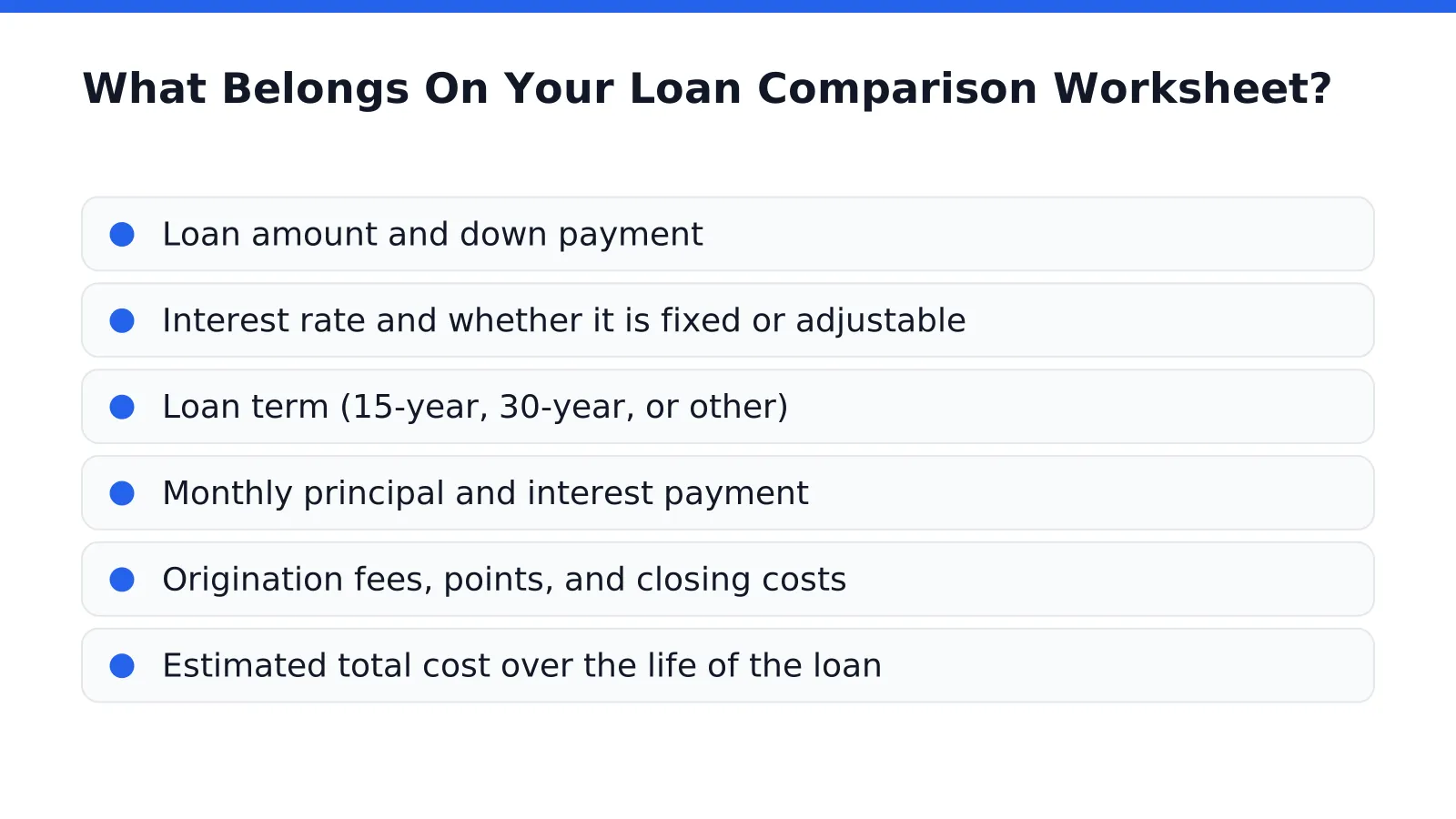
Five categories determine whether a mortgage offer saves money or costs it: rate, term, fees, payment structure, and total cost over time. A proper loan comparison worksheet tracks every factor that shapes monthly payments and the overall cost of a loan, not just the headline interest rate. Skipping a category means missing a cost that surfaces later, often after closing, when renegotiating is no longer an option.
A well-built loan worksheet does more than record numbers side by side. It helps borrowers match a mortgage option to their actual financial situation. Long-term goals, rather than the lowest advertised rate. Organizing offers this way turns a confusing stack of disclosures into a clear, line-by-line decision.
What rows should a mortgage comparison table include?
Each row should isolate one variable that affects cost or risk. A practical worksheet includes:
- Loan amount and down payment
- Interest rate and whether it is fixed or adjustable
- Loan term (15-year, 30-year, or other)
- Monthly principal and interest payment
- Origination fees, points, and closing costs
- Estimated total cost over the life of the loan
Why compare loan programs, not just lenders?
Program type often matters more than the lender issuing it. Munshi Capital Inc. offers residential and commercial programs including FHA, VA, USDA, and bank statement loans, giving borrowers real options to drop into each worksheet row. First-time buyers in Walnut Creek weighing a low-down-payment FHA loan against a conventional product need program-specific terms, not generic averages, to judge true cost.
Investors face a similar challenge when they compare mortgages across multiple property types or income-verification methods. A single lender offering a wide range of loan products simplifies that process. Every option lands on one worksheet instead of five separate lender portals.
How Does Munshi Capital Simplify The Process?
Transparency drives every stage of lending at Munshi Capital. Clients working through a loan comparison receive honest communication from first application through final closing, without jargon or hidden surprises. Walnut Creek borrowers juggling multiple offers need a lender that explains terms plainly, not one that buries conditions in fine print.
Speed matters just as much as clarity. Munshi Capital pairs modern technology with hands-on loan specialists, a combination that delivers quick pre-approvals alongside full visibility into loan status. Borrowers track progress at every step rather than waiting on updates or guessing where an application stands.
What makes the Munshi Capital process different for first-time buyers?
First-time homebuyers often struggle to interpret competing offers during a compare mortgages search. Munshi Capital’s specialists walk clients through each option so the financial picture stays understandable, not overwhelming. That guidance turns a confusing shopping phase into a structured decision.
How does technology support a faster closing?
Technology handles the repetitive tracking work, freeing loan specialists to focus on borrower questions and underwriting accuracy. Clients see real-time status updates instead of chasing phone calls for answers. The result is a closing timeline built on speed without sacrificing accuracy.
For investors comparing loan structures, a clear loan worksheet approach keeps every variable, rate, term, and fee, organized and easy to evaluate side by side. Munshi Capital’s process reflects that same discipline:
- Application: Borrowers submit financial details through a streamlined, guided intake.
- Underwriting: Specialists review documentation with transparent status tracking throughout.
- Closing: Clients close with clarity on terms, costs, and timelines, free of last-minute surprises.
Property sellers weighing their next move can request a direct cash offer to skip the traditional listing process entirely. Request your property assessment to understand current market value before deciding how to proceed.
Which Loan Programs Should You Compare First?
The right starting point depends on the borrower, not a one-size-fits-all list. Munshi Capital’s mortgage financing serves a wide selection of borrowers, from first-time homebuyers to seasoned investors. The first programs worth lining up side by side differ based on goals and financial history. A new buyer and a property investor rarely need the same loan comparison.
What should a first-time homebuyer compare first?
A first-time buyer’s priority sits with standard residential programs before anything specialized. Before approaching lenders at all, the borrower needs to settle one foundational question: fixed-rate or adjustable-rate mortgage. That single decision shapes every number on a future loan worksheet, from monthly payment stability to long-term interest exposure.
What should an investor compare first?
Investors face a different set of priorities. Beyond conventional residential products, specialized options like DSCR loans and hard money loans give investors financing routes that standard mortgages cannot match. These programs weigh property cash flow or speed of funding more heavily than personal income documentation, making them essential to review early.
Borrowers evaluating multiple paths should line up:
- Fixed-rate versus adjustable-rate residential programs
- Government-backed options for qualifying buyers
- DSCR loans for rental property cash flow
- Hard money loans for time-sensitive acquisitions
- Commercial programs for business-purpose financing
A broad product set across residential and commercial categories positions a lender as a genuine resource when borrowers try to compare mortgages rather than guess. Sellers weighing a property sale alongside financing decisions can request a direct cash offer to see how proceeds might fit into a new purchase.
Ready To Download Your Loan Comparison Worksheet?
A clear worksheet turns scattered lender quotes into a single, readable picture. Munshi Capital Inc. structures mortgage financing around each borrower, offering guidance through every loan program with straightforward answers instead of jargon. That structure gives borrowers in Walnut Creek and beyond a dependable starting point before signing anything.
Trust shapes every part of that structure. The approach stays rooted in clarity, honesty, and a service-driven standard, which makes transparent, borrower-first guidance the baseline rather than the exception. Borrowers reviewing a loan comparison against multiple offers need that consistency, especially when terms, fees, and rate types differ across lenders.
How does a loan worksheet help when comparing mortgage offers?
A loan worksheet lines up loan amount, rate type, and lender details side by side. Differences stand out instead of hiding in fine print. First-time buyers often assume one offer looks like another; a worksheet proves otherwise fast.
What’s the fastest way to start comparing loan options?
Borrowers can begin with a quick, secure application rather than scheduling several separate calls. That process lets a borrower share financial goals with a loan specialist. Identify which residential or commercial program fits best before committing to any single lender.
From there, the real value shows up in the comparison itself:
- Line up rate type, loan amount, and term across lenders
- Flag differences in fees before they surprise at closing
- Confirm which program actually matches long-term goals
Personalized guidance from a dedicated team helps borrowers nationwide move through this process with confidence. Ready to see where financing stands? Request a direct cash offer or request your property assessment to get the comparison started.
FAQ
How many lenders should I get quotes from before comparing?
Munshi Capital Inc. recommends gathering quotes from three to five lenders. This range gives borrowers enough data to spot differences in rates, fees, and terms without missing a materially better offer.
What details should my loan comparison worksheet include?
Track each lender’s name, contact, and date alongside interest rate, APR, loan term, monthly payment, closing costs, lender fees, and points charged. These categories reveal the true cost of each mortgage program side by side.
Which loan programs can I compare using this worksheet?
The worksheet works for FHA, VA, USDA, DSCR, bank statement, and hard money programs offered by Munshi Capital Inc. Organizing these options side by side gives Walnut Creek borrowers concrete figures before committing.
Conclusion
In closing, a comprehensive loan comparison worksheet serves as an essential tool for evaluating mortgage options with precision and objectivity. By systematically analyzing loan programs, terms, and costs, borrowers gain the clarity necessary to make informed financial decisions aligned with their specific circumstances. Munshi Capital Inc. remains committed to supporting this process through transparent guidance, diverse loan products, and personalized service that prioritizes your understanding at every stage of the lending journey.
Leave a Reply