
Common mortgage myths mislead first-time homebuyers, self-employed borrowers, and investors into delaying homeownership unnecessarily. Munshi Capital Inc. confirms a 20% down payment is not required for every loan. FHA, VA, USDA, DSCR, and bank statement programs offer flexible qualification paths, proving financing options exist beyond conventional assumptions for diverse financial situations nationwide.
Key Takeaways
- You need 3-20% down payment depending on your loan program, not necessarily 20% for all mortgages.
- FHA, VA, and USDA loans offer specialized financing options tailored to specific borrower circumstances and goals.
- Mortgage requirements and lending standards evolve yearly, making outdated advice from family or social media unreliable today.
- Transparent communication with loan specialists clarifies your actual financial picture and eliminates confusion throughout the entire process.
Are Mortgage Myths Standing Between You and Homeownership?
Confusion, not income or credit history, stops many prospective buyers from starting the loan process. Conflicting advice from family, social media, and outdated rules of thumb creates a fog around financing that delays action for months or years. This mortgage myths debunked confusion carries a real cost: buyers who wait on bad information miss rate windows, lose negotiating leverage, and watch inventory shift in competitive markets.
Clarity changes that equation. Separating fact from fiction is essential for making informed decisions about a mortgage. Borrowers who understand their actual options move faster and with more confidence than those relying on secondhand assumptions.
Why Does Myth vs. Fact Matter So Much in Mortgage Lending?
Treating every mortgage rule as universal law is where buyers get stuck. A myth vs fact mortgages comparison matters because lending guidelines vary by loan program, borrower type, and financial profile. A rule that applied to a neighbor’s purchase may not apply at all.
How Does Munshi Capital Approach Mortgage Facts?
Munshi Capital built its lending approach on trust and borrower-first guidance, not sales pressure. The mission centers on transparency, ensuring clarity and honest communication at every stage of the lending process. That commitment turns a confusing topic into a manageable one:
- Clear explanations instead of jargon-heavy disclosures
- Honest answers to direct questions about eligibility
- Guidance rooted in each borrower’s actual financial picture, not generic assumptions
This mortgage facts guide approach reflects a broader service-driven ethos: clients deserve straight answers before they sign anything. For sellers weighing their next move, the same philosophy applies, and those ready to act can request a direct cash offer or request your property assessment to see where they stand before making a decision.

Do You Really Need a 20% Down Payment?
No, a 20% down payment is not a requirement for securing a mortgage. This figure ranks among the most persistent myths in home financing. It misleads countless first-time buyers into delaying their purchase. Many borrowers qualify with far less upfront cash than this old rule suggests.
This guide to mortgage facts separates lending reality from outdated assumptions. A larger down payment carries real advantages: borrowers who put down 20% typically avoid private mortgage insurance (PMI), an added monthly cost tied to lower-equity loans. That benefit, however, does not make 20% the only entry point into homeownership.
Does a Bigger Down Payment Guarantee a Lower Rate?
No. Pricing a mortgage rate involves multiple factors beyond the size of the down payment. Credit profile, loan type, and overall financial picture all play a role. A borrower putting down more cash is not automatically rewarded with a better rate.
Munshi Capital Inc. structures its residential loan programs around this reality, not the myth. The company offers FHA, VA, and USDA loans, each designed for borrowers at different down payment levels and financial starting points. This range reflects the kind of myth vs. fact mortgage comparison every buyer deserves before ruling themselves out of homeownership.
Consider the practical differences:
- FHA loans: built for buyers who cannot meet a large down payment threshold
- VA loans: designed for eligible military borrowers, often with reduced down payment burdens
- USDA loans: structured for qualifying rural and suburban purchases
This mortgage myths debunked breakdown makes one point clear: down payment size is flexible, not fixed. Borrowers exploring their options can request your property assessment to understand exactly what a purchase requires before writing off the possibility entirely.
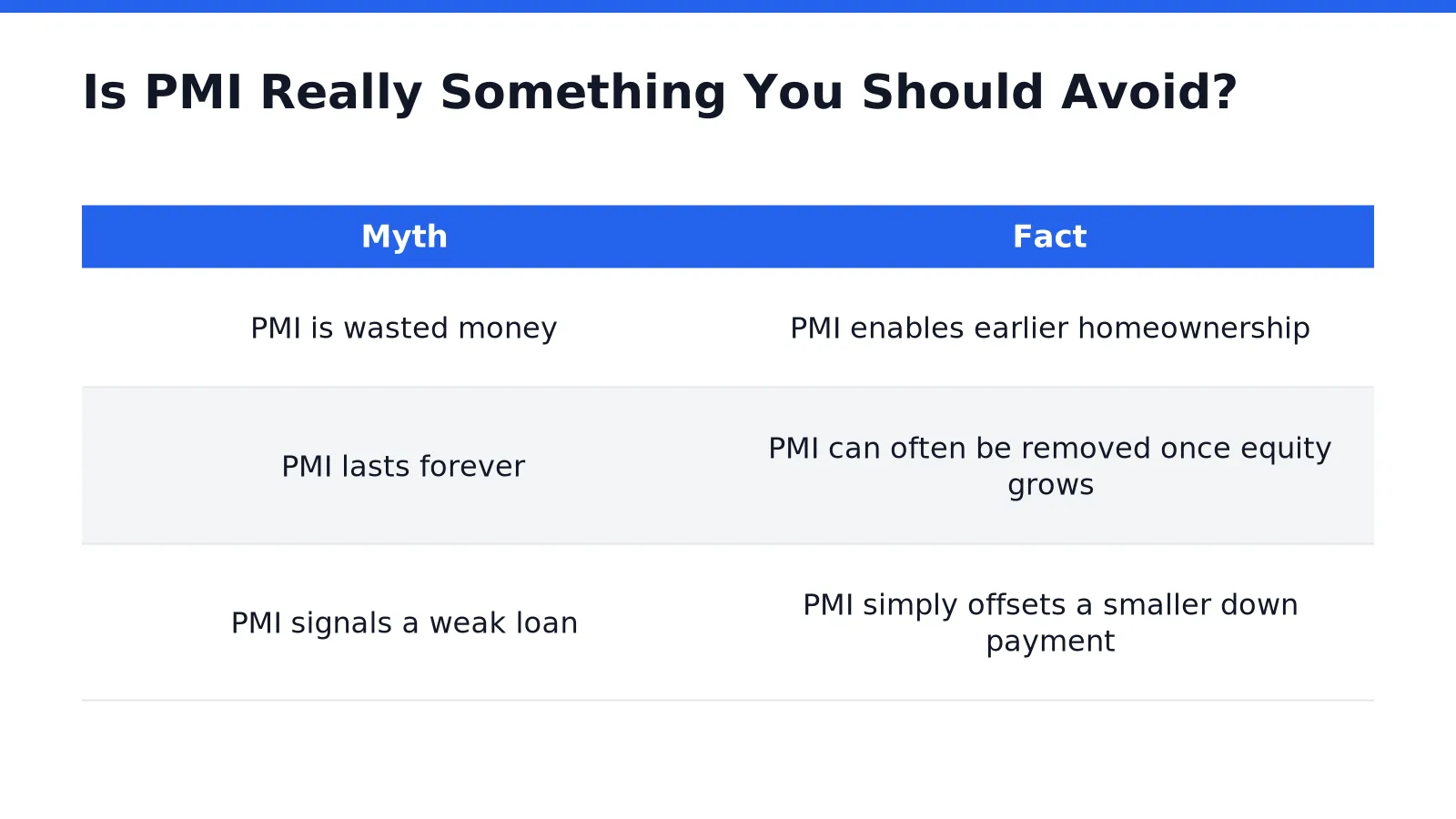
Is PMI Really Something You Should Avoid?
Private mortgage insurance carries an unfair reputation among home shoppers. Many borrowers wrongly believe PMI should always be avoided, treating it as a penalty rather than a tool. This belief sits at the center of several mortgage myths debunked by careful review of how financing actually works.
PMI exists to protect lenders when a down payment falls below a certain threshold, not to punish buyers. For borrowers without a large cash reserve, PMI often opens the door to homeownership years sooner than waiting to save a bigger down payment would allow. Dismissing it outright can mean missing a home purchase altogether.
Does PMI mean a bad loan?
No. PMI reflects the size of a down payment, not the quality of the loan terms. Many loans with PMI still carry competitive rates and reasonable monthly costs once the full picture is calculated.
A clear myth vs fact mortgages comparison helps separate assumption from reality:
Munshi Capital’s loan specialists pair modern technology with hands-on guidance, walking borrowers through exactly what PMI costs and why it applies. The company’s application, underwriting, and closing process is built for clarity, removing hidden surprises at every stage. This mortgage facts guide approach, paired with dependable service across every loan program, helps borrowers judge PMI on facts rather than assumption.

Can Self-Employed Borrowers and Investors Actually Qualify?
Self-employed applicants and property investors qualify for mortgage financing regularly, despite the persistent assumption that irregular income or investment property disqualifies them. Munshi Capital Inc. built specialized DSCR and hard money loan products specifically for investor-focused financing, addressing a gap that traditional lenders often leave unfilled. These programs evaluate a property’s cash flow rather than relying solely on a borrower’s personal tax returns, which widens the door for landlords and business owners alike.
This reality sits at the center of any honest mortgage myths debunked discussion. A business owner with fluctuating monthly income is not automatically a high-risk borrower. The real test mirrors a simpler comparison: if a borrower already covers a monthly rent payment reliably, that borrower may well afford a comparable mortgage payment.
Do Self-Employed Borrowers Need Special Documentation?
Self-employed borrowers typically work with underwriting paths designed around their income structure rather than a standard pay stub. Munshi Capital Inc. offers personalized guidance to borrowers nationwide, including self-employed applicants navigating these alternative documentation routes with confidence.
How Can Investors Check Qualification Before Applying?
Investors and self-employed borrowers can request a quick, non-binding prequalification estimate before submitting a full application. This step offers a realistic sense of borrowing power without locking anyone into a commitment.
Separating myth versus fact in mortgages matters most for borrowers who assume their nontraditional income disqualifies them outright. It rarely does. For a practical mortgage facts guide, the clearest starting point is a direct comparison:
Borrowers ready to move forward on an investment purchase can request a direct cash offer. Those weighing a sale alongside a purchase can request your property assessment to clarify next steps.
How Do You Separate Mortgage Fact From Fiction?
Separating mortgage fact from fiction starts with checking every claim against a lender’s actual guidelines, not a relative’s recollection from a decade-old purchase. A clear mortgage facts guide replaces guesswork with documented loan requirements. Clearing up these misconceptions helps buyers feel more confident, prepared, and in control of each step ahead.
Borrowers benefit most from treating this as an ongoing comparison exercise rather than a one-time lesson. That comparison, often called myth vs. fact mortgages, works best when weighed side by side.
Why Does Working With a Trusted Lender Matter?
A lender’s integrity shapes whether a borrower actually gets accurate answers. Munshi Capital Inc. built its reputation on a wide range of loan products and a client-first ethos, serving first-time buyers, self-employed applicants, and investors nationwide with the same consistency.
Can Technology Really Speed Up Pre-Approval?
Yes. Modern platforms paired with hands-on loan specialists give borrowers faster pre-approvals. Full visibility into where their application stands at every stage. No guessing, no radio silence.
Transparency remains the real safeguard against myths. An honest mortgage myths debunked approach means every answer gets rooted in clarity, not assumption. Borrowers can move forward with confidence instead of outdated rules of thumb.
FAQ
Do you need a 20% down payment to get a mortgage?
No, a 20% down payment isn’t required for every loan. Depending on the program, borrowers can qualify with down payments ranging from 3% to 20%.
Why do mortgage myths cost homebuyers real opportunities?
Buyers who
Conclusion
In closing, separating mortgage fact from fiction empowers borrowers to make informed decisions aligned with their financial circumstances. Munshi Capital Inc. remains committed to dispelling misconceptions through transparent communication and personalized guidance, ensuring every borrower, whether a first-time homebuyer or seasoned investor, understands their options with absolute clarity. By prioritizing honesty and straightforward processes, we eliminate the confusion that often surrounds mortgage financing, enabling you to move forward with confidence in your lending journey.
Leave a Reply