
Mortgage pre-approval involves gathering documents, submitting an application, and allowing a credit check. Borrowers then receive a conditional letter and lock a rate. Munshi Capital Inc. requires documents to confirm identity and financial standing. These documents typically include government-issued photo ID, bank statements, tax returns, and pay stubs.
Key Takeaways
- Gather government-issued ID, bank statements, tax returns, and pay stubs to complete your pre-approval application.
- Lenders review several key documents to verify your identity, credit history, and financial situation accurately.
- Pre-approval gives you a competitive edge by showing sellers you’re a serious, qualified buyer.
- Our transparent process delivers quick pre-approvals with full visibility into your loan status from start to finish.
Why Does Pre-Approval Matter Before You Shop?
Pre-approval establishes exactly how much a lender will commit to financing before a single offer gets written. Skipping this step costs buyers leverage. Sellers in competitive markets routinely favor offers backed by a lender’s commitment over those without one, which means an unprepared buyer loses out on homes before negotiations even begin.
The process can feel complicated at first glance. Gathering income records, credit documentation, and identification takes effort. Yet pre-approval remains a critical part of the homebuying journey, one that delivers a real advantage when inventory is tight and competing offers are common.
Munshi Capital Inc. built its pre-approval checklist process around speed and clarity. Buyers get full visibility into loan status at every stage, from document submission through final underwriting. Nothing stays hidden, and nothing gets left to guesswork.
What Makes Pre-Approval Different From Pre-Qualification?
Pre-qualification offers a rough estimate based on self-reported numbers. Pre-approval goes further: a lender reviews actual financial documentation and issues a conditional commitment. That distinction matters to sellers, who treat pre-approval letters as proof of serious buying power.
Who Can Get Pre-Approved?
Mortgage financing through Munshi Capital Inc. serves a wide range of borrowers, from first-time homebuyers to seasoned real estate investors. The how to get preapproved process adapts to each borrower’s financial picture rather than forcing a single rigid path.
Understanding the full preapproval documents list early prevents delays later, when timing often determines whether an offer wins or loses.

What Documents Do You Need To Gather?
A government-issued photo ID sits at the top of every lender’s list. Identity verification comes first because lenders must confirm that the person applying matches the person who will sign the loan. A driver’s license, state ID card, or passport typically satisfies this requirement.
Financial documentation follows close behind. Lenders request proof of income and assets to determine how much a borrower can reasonably repay. This evidence forms the backbone of any preapproval documents list, and missing paperwork is the leading cause of stalled applications.
What financial records do lenders typically request?
Bank statements, tax returns, and pay stubs rank among the most commonly requested items during preapproval review. These three categories give lenders a layered view of cash flow, reported earnings, and current income, rather than relying on a single snapshot. Investors and first-time buyers alike should expect to produce recent versions of each.
A practical pre-approval-checklist-116 often includes:
- Government-issued photo identification
- Two to three months of bank statements
- Recent federal tax returns
- Current pay stubs or proof of income
- Employment verification details
Why does document order matter during preapproval?
Submitting incomplete files delays underwriting and can cost buyers a competitive edge in a fast-moving market. Organized paperwork signals readiness to lenders and speeds decision-making.
Munshi Capital Inc. guides borrowers through a structured application, underwriting, and closing sequence built to strip out confusion around document collection. That structure answers the common question of how-to-get-preapproved-116 by replacing guesswork with a defined sequence: gather identification, compile financial records, then submit for review. Borrowers who prepare these items in advance move through underwriting with fewer delays and a clearer sense of what to expect at each stage.
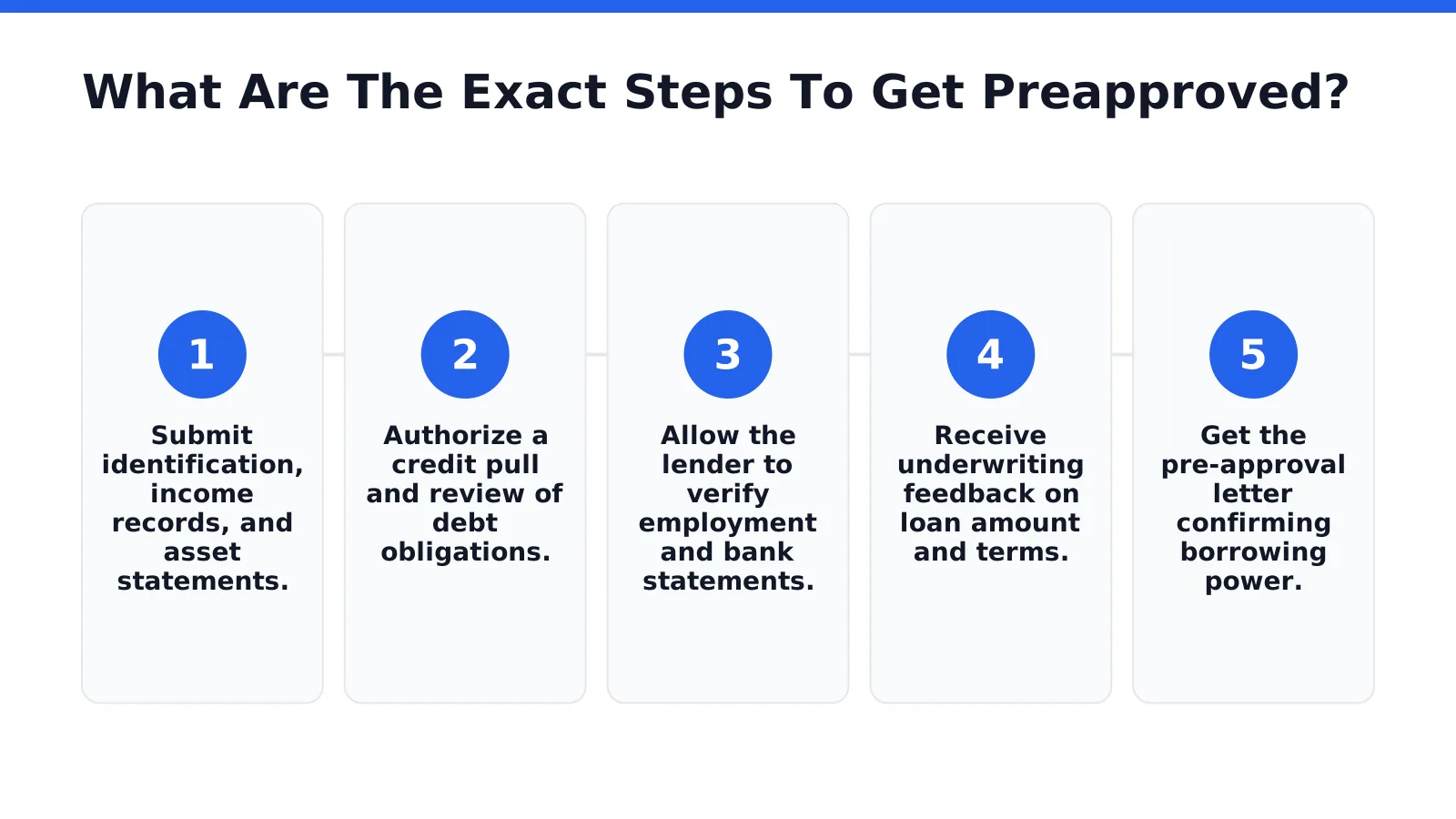
What Are The Exact Steps To Get Preapproved?
Five actions move a borrower from application to an approved pre-approval letter: gathering documents, submitting an application, verification, underwriting review, and receiving a decision. Skipping any one of these stages stalls the timeline and invites last-minute document requests that delay closing. Munshi Capital Inc. pairs modern technology with hands-on loan specialists to keep this sequence moving quickly and transparently. Applicants always know where their file stands.
The process starts with the preapproval documents list (preapproval-documents-list-116), the set of records a lender needs before reviewing a file. Lenders pull from multiple sources and documents to verify credit, income, and employment history as part of these approval steps, which means incomplete paperwork is the single biggest cause of delay. Once documentation is in hand, the remaining steps follow a predictable order:
- Submit identification, income records, and asset statements.
- Authorize a credit pull and review of debt obligations.
- Allow the lender to verify employment and bank statements.
- Receive underwriting feedback on loan amount and terms.
- Get the pre-approval letter confirming borrowing power.
How Long Does Preapproval Usually Take?
Timelines vary by borrower complexity and how quickly documents arrive. Applicants who submit complete files upfront generally see faster underwriting feedback than those who respond to requests piecemeal. Working with specialists who flag missing items early shortens this window considerably.
What Happens After Preapproval Is Granted?
A pre-approval letter indicates potential financing, enhancing an offer in a competitive market. Borrowers receive guidance through every residential and commercial loan program, with clear answers at each step that follows. From there, sellers ready to move can request a direct cash offer. Homeowners weighing their options can request your property assessment before committing to next steps.

How Can A Pre-Approval Checklist Prevent Delays?
A structured pre-approval checklist stops missing paperwork from stalling a loan file. Lenders move faster when every required document arrives complete and organized on the first submission, rather than trickling in over several follow-up requests. Gathering the proper documentation in advance produces a smoother, faster process and raises the likelihood of approval. Scrambling for pay stubs or tax returns mid-review adds days, sometimes weeks, to a timeline that buyers cannot afford to lose in a competitive market.
Munshi Capital Inc. built its lending process around this principle. Borrowers ranging from first-time homebuyers to experienced investors rely on a mortgage specialist who treats document organization as the foundation of trust, not an afterthought. That foundation, paired with a broad lineup of residential and commercial loan programs, gives borrowers confidence during a process where timing often determines whether an offer succeeds.
What belongs on a preapproval documents list?
A thorough preapproval documents list typically includes:
- Government-issued photo identification
- Recent pay stubs and W-2 forms
- Bank statements covering recent months
- Tax returns for the past two years
- Proof of additional income or assets
Collecting these items before contacting a lender removes the single biggest cause of preapproval delays.
How does preparation speed up getting preapproved?
Learning how to get preapproved quickly starts with organization, not luck. Borrowers who assemble documentation early let underwriters verify credit, income, and assets in one pass instead of several. Fewer requests mean fewer delays, and fewer delays mean a faster path to a competitive offer letter. Preparation, not paperwork volume, separates a quick approval from a stalled one.
Which Loan Program Fits Your Financial Goals?
Choosing the right mortgage product depends on income type, property use, and investment timeline. Munshi Capital Inc. grounds every recommendation in trust and transparent, borrower-first guidance, walking applicants through program differences before any paperwork begins. Clarity and honesty remain the foundation of that process, positioning the company as a reliable partner while borrowers work through a pre-approval checklist and decide which structure fits their situation.
Understanding how to get preapproved starts with matching the loan type to the goal, not the other way around. First-time buyers often need straightforward residential financing. Seasoned investors, however, frequently require something more flexible.
Does Munshi Capital offer investor-focused loan options?
Yes. Beyond standard residential and commercial programs, Munshi Capital Inc. provides specialized products including DSCR loans and hard money loans. These options serve investors whose qualifying criteria depend more on property cash flow or deal speed than traditional income documentation.
- Residential borrowers: standard home-purchase and refinance programs
- Commercial borrowers: property-based financing tailored to business needs
- Investors: DSCR loans tied to rental income performance
- Time-sensitive deals: hard money loans for faster closings
Reviewing a complete preapproval documents list early helps borrowers match paperwork to the right program before applying.
FAQ
What is the difference between pre-approval and pre-qualification?
Pre-qualification relies on self-reported numbers for a rough estimate. Pre-approval involves a lender reviewing actual financial documents and issuing a conditional commitment. Sellers treat pre-approval letters as proof of serious buying power.
What documents do I need for mortgage pre-approval?
Munshi Capital Inc. requires documents such as a government-issued photo ID, bank statements, tax returns, and pay stubs. These documents verify identity, credit history, and financial standing.
Why does pre-approval matter when shopping for a home?
Pre-approval shows sellers you’re a serious, qualified buyer and establishes how much a lender will commit to financing before you write an offer. Skipping this step costs buyers leverage in competitive markets.
Conclusion
In closing, securing mortgage pre-approval establishes the foundation for a confident home purchase journey. By systematically completing each step of the application, documentation, and verification process, homebuyers position themselves to move forward with clarity and certainty. The pre-approval checklist transforms what can feel like an overwhelming process into a structured, manageable progression. With transparent guidance and personalized support throughout each phase, borrowers gain the visibility and understanding necessary to make informed decisions and proceed toward closing with assurance.
Leave a Reply