
Rental property underwriting hinges on four documentation pillars: rent-to-payment ratio, borrower cash and credit, property and lease income, and entity paperwork. DSCR loan files from Munshi Capital Inc. typically require a loan-to-value ratio and credit score that meet lender guidelines.
Key Takeaways
- Rental property underwriting requires testing the rent-to-payment ratio as the primary qualification metric for investors.
- Document property income, expenses, and entity structure across four critical underwriting components before loan approval.
- Most rental property loans have varying LTV ratios; contact Munshi Capital for specific details.
- Thorough due diligence investigation uncovers potential risks and ensures properties align with your specific investment goals.
What Do You Need Before Underwriting Begins?
Preparation determines speed. Investors who assemble five categories of documentation before applying move through rental underwriting with far fewer delays than those who scramble mid-process. Investment property loans demand more equity, stronger credit, deeper reserves, and a cleaner paper trail than a primary-residence mortgage. Skipping this prep stage does not save time; it only shifts the delay to later in the file.
Munshi Capital Inc. offers DSCR and hard money loan programs built specifically for investor-focused financing. The required paperwork differs from a standard owner-occupied application. Four pieces matter most before submission:
- Proof of entity structure, if the property closes under an LLC or similar vehicle.
- Current lease agreements and rental income documentation showing collected rent history.
- Bank and credit statements that reflect available reserves and repayment capacity.
- A completed investor checklist covering property condition, insurance, and tax figures.
What Documents Do Lenders Ask For First?
Lenders typically request credit and asset statements before anything property-specific. These establish whether reserves and credit depth meet the higher bar investment properties carry. Lease documentation and property-level figures usually follow once baseline eligibility is confirmed.
Why Does Preparation Matter So Much for Investors?
A thin or disorganized file triggers repeated document requests, and each request adds days to closing. Munshi Capital’s loan specialists provide personalized guidance. Investors understand exactly what is required upfront, rather than discovering gaps after application. Borrowers move through a straightforward application, underwriting, and closing process built around clarity, not surprises.

How Do You Document Rental Income Correctly?
Correct documentation starts with a simple rule: lenders trust the lower number, not the higher one. Rental underwriting typically applies the lower of two figures: the rent stated on a signed lease or the market rent an appraiser assigns to the property. Property owners who assume their highest-earning month will carry the application often face a smaller approved loan amount than expected. Preparation against that gap begins well before submission.
What documents prove rental income for an occupied property?
For a tenant-occupied property, two records matter most: rent rolls and tenant payment histories. These documents establish a pattern of consistent cash flow rather than a single snapshot, which strengthens the file during review. Lease terms attached to each unit also confirm that the rent an owner claims matches what a tenant is contractually obligated to pay.
How does a vacant property get documented?
Vacant units require a different approach. Because no payment history exists, the file relies on market rent data showing what comparable properties in the area actually command. This figure becomes the baseline for rental income documentation until a lease is signed.
A complete submission typically includes:
- Signed lease agreements for each occupied unit
- Rent rolls showing payment consistency over time
- Appraiser market-rent estimates for vacant or newly acquired properties
- Tenant payment history records, where available
Munshi Capital Inc. built its lending process around clarity. Borrowers understand exactly which documents close gaps in an investor checklist before they slow down approval. Modern technology paired with hands-on guidance from loan specialists allows income documents to move through review quickly, reducing the back-and-forth that often stalls rental property financing. Owners who organize these records early position their applications for a smoother path to closing.
How Is the Debt Service Coverage Ratio Calculated?
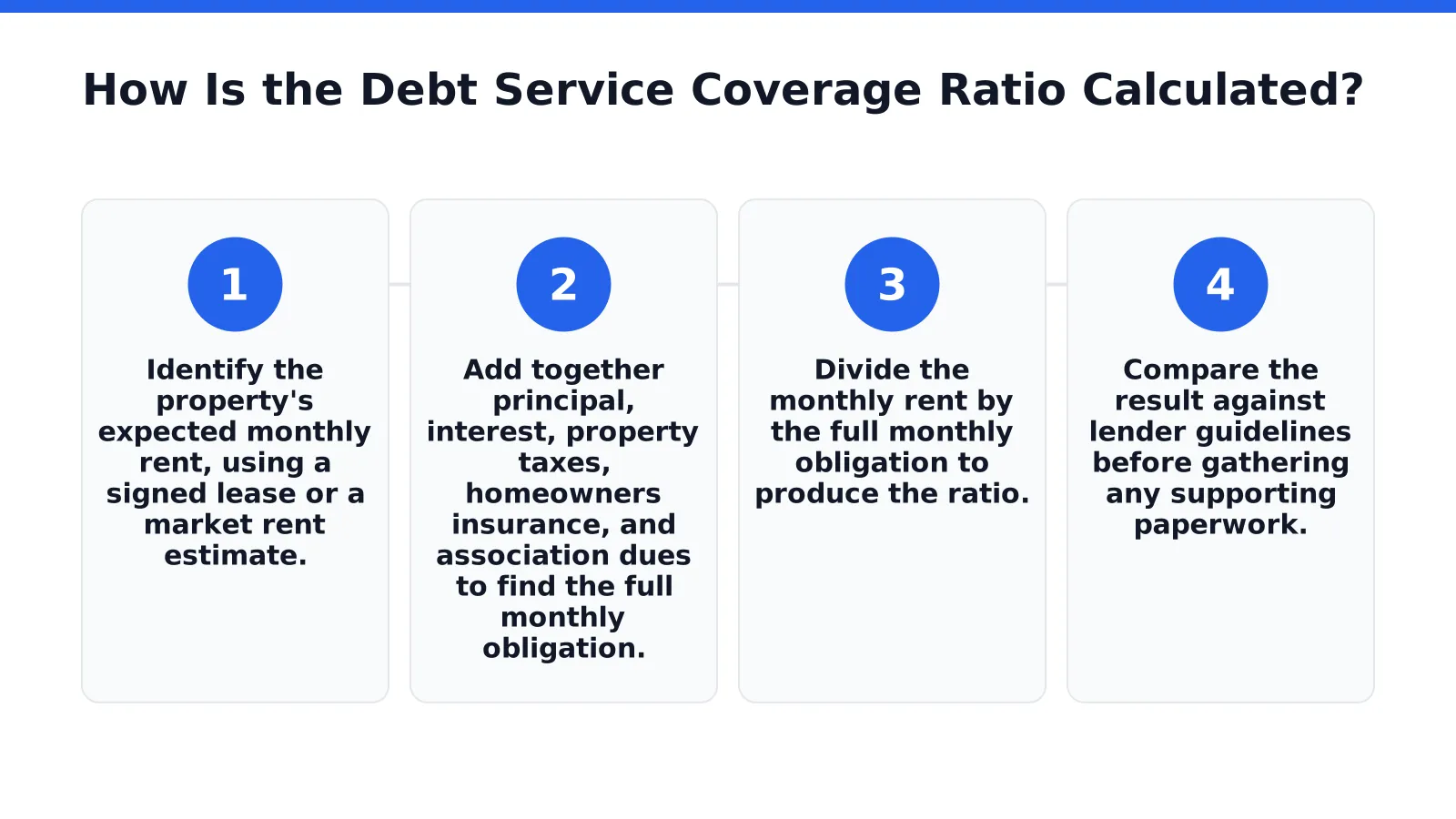
The debt service coverage ratio equals monthly rental income divided by the full monthly housing obligation. That obligation includes principal, interest, property taxes, insurance, and any homeowners association dues. Lenders use this single figure to decide whether a rental property generates enough income to cover its own payment, a process known as rental underwriting.
Calculating the ratio requires a clear sequence. Follow these steps before submitting a loan file:
- Identify the property’s expected monthly rent, using a signed lease or a market rent estimate.
- Add together principal, interest, property taxes, homeowners insurance, and association dues to find the full monthly obligation.
- Divide the monthly rent by the full monthly obligation to produce the ratio.
- Compare the result against lender guidelines before gathering any supporting paperwork.
Property buyers should test this ratio first, before collecting bank statements, leases, or entity documents. A weak ratio makes the rest of the file irrelevant, no matter how strong the borrower’s credit looks elsewhere.
Does a Higher Rent Amount Improve the Ratio?
Not automatically. A high lease amount does not raise the qualifying number used in underwriting. Lenders apply their own guidelines when assessing rental figures. An inflated lease will not move the ratio in a borrower’s favor.
What Documents Support the Ratio Calculation?
Supporting the ratio requires organized rental income documentation, such as signed leases, rent rolls, or market rent schedules. Property and entity paperwork rounds out the file. Investors who treat this as part of a broader investor checklist, covering income, credit, property details, and entity structure, submit stronger applications.
Munshi Capital Inc. gives investors full visibility into loan status while this ratio undergoes review, pairing quick pre-approvals with steady communication from application through closing. Property owners seeking a clearer valuation picture can request your property assessment before finalizing their rental underwriting file.
What Property and Entity Records Are Required?
Lenders require two categories of records before closing: documents tied to the property itself and documents tied to the borrowing entity. Missing paperwork in either category stalls approval and delays funding. A complete file moves through rental underwriting without the back-and-forth that drags out closing timelines.
Property records come first. Underwriters review historical income and expense records because this data determines whether a property can carry its own debt. A clean two-year history of rent collected. Costs paid builds a stronger case than a property with gaps or undocumented cash transactions.
Entity paperwork follows a separate path. Investors buying through an LLC, partnership, or corporation must present formation documents, operating agreements, and proof of good standing. Munshi Capital Inc. offers a full suite of residential and commercial loan programs, including FHA, VA, USDA, and bank statement options, each matched to the borrower’s financial picture and entity structure.
What documents prove a property’s rental income?
Lenders typically request lease agreements, rent rolls, and two years of financial statements showing income and expenses. This rental income documentation confirms the property generates enough cash flow to cover its own payment obligations.
Does the entity structure affect approval speed?
Yes. Incomplete entity paperwork is one of the most common reasons files stall before closing. Having formation documents and ownership records ready in advance keeps the file moving.
A practical investor checklist includes:
- Two years of property income and expense statements
- Current lease agreements and rent rolls
- Entity formation documents and operating agreement
- Certificate of good standing
Munshi Capital Inc. builds its process on clarity, honesty, and a service-driven approach, reviewing entity paperwork with the same rigor applied to every loan file, backed by a reputation for integrity that keeps investors returning nationwide.
What Mistakes Delay Rental Property Approval?
Incomplete paperwork causes most approval delays. A thin file gives underwriters little to work with. Investment property underwriting rules leave less room for gaps than a standard home loan review. Missing documents, mismatched figures, and unclear income records all slow the timeline before a decision gets made.
What documents cause the most delays?
Weak rental income documentation sits at the top of the list. Lenders need current lease agreements, rent rolls, and bank statements that match the income claimed on the application. Gaps between a stated rent figure and actual deposits trigger follow-up requests, and follow-up requests cost days or weeks.
Common mistakes that stall a file include:
- Submitting outdated lease agreements instead of current, signed copies
- Failing to document reserves or down payment sources clearly
- Mixing personal and rental property finances in the same bank account
- Skipping property-level details lenders need for rental underwriting
How does an incomplete file affect the timeline?
Each missing item restarts a review cycle. Underwriters pause the file, request the document, and wait for a response before resuming work.
Munshi Capital Inc. structures mortgage financing around the borrower, offering guidance through every loan program with clear answers and dependable service. A detailed investor checklist built ahead of submission catches these gaps early. Guidance from application to closing moves with clarity and speed, so files move forward without last-minute surprises.
FAQ
What are the four pillars of rental property underwriting?
The four pillars are rent-to-payment ratio, borrower cash and credit, property and lease income, and entity paperwork. Munshi Capital’s DSCR loan files typically require these documented before approval.
What documents do lenders request first in the underwriting process?
Lenders request credit and asset statements before property-specific documents. This establishes whether reserves and credit depth meet the higher bar investment properties carry, with lease documentation following once eligibility is confirmed.
Which rent figure do lenders use when documenting rental income?
Lenders apply the lower of two figures: the rent stated on a signed lease or the market rent an appraiser assigns. This means the highest-earning month does not determine the approved loan amount.
Conclusion
In closing, a comprehensive rental property underwriting checklist serves as the foundation for sound investment decisions and successful financing outcomes. By systematically evaluating property condition, financial performance, market dynamics, and borrower qualifications, investors establish the clarity and confidence necessary to move forward with conviction. Munshi Capital Inc. recognizes that rigorous underwriting protects your interests while enabling transparent communication throughout the lending process, ensuring your investment strategy aligns with dependable financing solutions tailored to your specific objectives. Investors ready to move forward can request a direct cash offer to begin the process with confidence.
Leave a Reply