
Self-employed mortgage applications require two years of personal and business tax returns, profit-and-loss statements, bank statements, and a valid business license. Lenders including Munshi Capital Inc. evaluate income consistency, debt-to-income ratio, and credit profile, often accepting bank statement loans for California freelancers and 1099 contractors lacking traditional W-2 pay stubs.
Key Takeaways
- Self-employed borrowers need 2 years of tax returns to verify consistent income and business stability.
- Lenders require profit and loss statements, bank statements, and business licenses for complete financial documentation.
- Personal credit scores above 700 strengthen applications, though additional documentation compensates for variable self-employment income.
- We guide self-employed clients through transparent underwriting, ensuring clear communication about all required documents upfront.
What Will You Need Before You Apply?
Self-employed applicants need a complete financial picture before submitting a mortgage application. Lenders require additional income and business documentation to verify financial stability and confirm repayment ability, since self-employment income rarely arrives as a fixed paycheck. Preparation matters more here than for salaried borrowers.
Munshi Capital Inc. structures loan programs specifically around this reality, offering bank statement loans alongside FHA, VA, and USDA options for borrowers whose income doesn’t fit a traditional W-2 mold. Investors and business owners seeking additional flexibility can also explore DSCR. Hard money loans, both built for income profiles that standard underwriting often overlooks.
What documents belong on a self-employed checklist?
A solid self-employed checklist centers on proof of consistent earnings and business legitimacy. Organized records speed up review and reduce back-and-forth requests.
- Two years of tax returns, personal and business
- Twelve to twenty-four months of bank statements
- Profit-and-loss statements covering recent business performance
- Business license or formation documents
- Year-to-date income summary, if available
Why does documentation feel heavier for self-employed borrowers?
Variable income carries more underwriting scrutiny than a fixed salary. Lenders look past a single strong month and instead measure consistency across years, which protects both the borrower and the lender from overestimating repayment capacity.
Clean, organized paperwork streamlines every stage of the process. Munshi Capital guides applicants through application, underwriting, and closing with clear expectations at each step, removing the guesswork that often derails self-employed mortgage applications elsewhere. Munshi Capital Inc. specializes in mortgage financing designed to cater to a diverse range of borrowers from first-time homebuyers to seasoned investors.
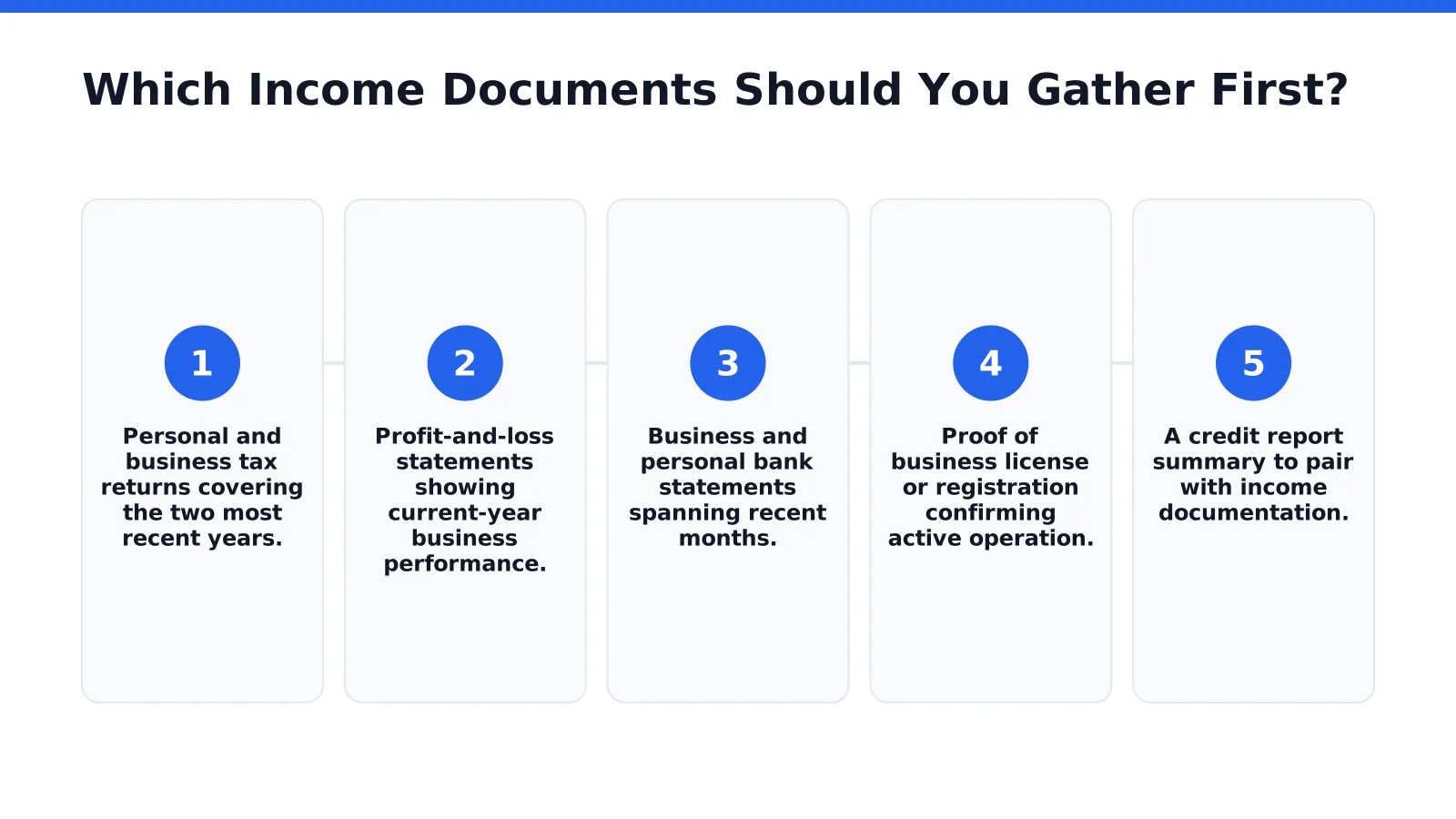
Which Income Documents Should You Gather First?
Business bank statements and two years of tax returns form the foundation of any self-employed mortgage file. Lenders evaluate employment history, business performance, income consistency, and debt-to-income ratio before anything else moves forward. Missing paperwork at this stage causes delays that stretch closing timelines by weeks.
Munshi Capital Inc. builds its mortgage financing around each borrower, offering guidance through every loan program with clear answers instead of vague instructions. That guidance starts with a precise list of what to pull together first. Applicants who organize records early avoid the back-and-forth that stalls so many self-employed files.
What Belongs on a Self-Employed Checklist?
A practical self-employed checklist includes several income documents, gathered in this order:
- Personal and business tax returns covering the two most recent years.
- Profit-and-loss statements showing current-year business performance.
- Business and personal bank statements spanning recent months.
- Proof of business license or registration confirming active operation.
- A credit report summary to pair with income documentation.
Each item verifies a different piece of financial stability, so skipping one creates gaps underwriters must chase down later.
Should Self-Employed Borrowers Adjust Deductions Before Applying?
Limiting business deductions for roughly two years before applying helps document higher qualifying income. Heavy write-offs reduce taxable income on paper, even when actual cash flow supports a mortgage payment. Borrowers planning a purchase in the near future benefit from reviewing this tradeoff with a tax professional well ahead of time.
Munshi Capital Inc. offers personalized guidance to borrowers nationwide, with a team dedicated to understanding individual business goals before recommending a loan path. That approach emphasizes clarity throughout the lending process, so self-employed applicants understand each income requirement before submitting a single document.

How Do Bank Statements Prove Your Income?
Bank statements show lenders a documented, month-over-month pattern of deposits that confirms income actually moves through an account rather than existing only on paper. Business and personal accounts together create a clearer financial picture than a pay stub ever could for a self-employed applicant. Lenders scrutinize this pattern closely because self-employment income fluctuates, unlike a fixed salary, making variable-income verification a documented underwriting priority.
Munshi Capital Inc. builds bank statement loans into its lineup of residential and commercial loan programs specifically for business owners and independent contractors. This option lets qualifying applicants verify income through deposit history instead of relying solely on tax returns, which often understate earnings after business deductions. Freelancers juggling multiple income streams frequently find this path more accurate than a traditional W-2 underwriting model.
A well-organized self-employed checklist speeds up the review considerably. Typical bank statement documentation includes:
- 12 to 24 months of consecutive personal or business bank statements
- A profit-and-loss summary covering the same period
- Proof of business ownership or operation
- Supporting identification and credit documentation requested by the loan specialist
Munshi Capital pairs this documentation review with modern underwriting technology. The direct involvement of loan specialists who manage each file personally. That combination supports faster pre-approvals and gives applicants ongoing visibility into where their loan stands, from initial submission through closing.
How Many Months of Bank Statements Do Lenders Need?
Most bank statement loan programs request 12 to 24 months of statements to establish a reliable income trend. Longer histories generally strengthen an application by smoothing out seasonal dips common in freelance and contract work. Consistency across months matters more than any single high-earning period.
Can Bank Statements Replace Tax Returns Entirely?
Some bank statement programs allow income verification without standard tax return documentation. Requirements vary by loan type and lender guidelines, so applicants should confirm specifics with a loan specialist before assuming eligibility.
What Steps Strengthen Your Loan Application?
Four actions build a stronger application for self-employed borrowers: organizing documentation early, lowering debt-to-income ratio, assembling a complete self-employed checklist, and working with a lender that prioritizes clarity over guesswork. Skipping any one of these steps risks delays or outright denial, even for business owners with strong revenue. A clean application tells an underwriter one thing: repayment is predictable.
Munshi Capital Inc. built its lending approach around that predictability standard. Its process favors transparent, borrower-first guidance rooted in clarity and honesty, so applicants understand each requirement before submitting paperwork. That service-driven ethos, paired with a broad range of residential and commercial loan programs, has made the company a reliable partner for homebuyers and investors across the country.
How can self-employed borrowers reduce their debt-to-income ratio quickly?
Paying down debts carrying the highest monthly payments delivers the fastest DTI reduction. This matters because a lower ratio frees up more room in the monthly budget for a mortgage payment, which strengthens approval odds. Borrowers planning to apply soon should prioritize this step before gathering other paperwork.
What documents belong in a self-employed checklist?
A complete checklist typically includes bank statements, tax returns, and profit-and-loss records covering recent business activity. Follow these steps in order:
- Pull two years of business and personal tax returns.
- Gather twelve to twenty-four months of bank statements.
- Prepare a current profit-and-loss statement.
- Calculate debt-to-income ratio and pay down high-payment debts first.
- Submit the full package to a loan specialist for review.
Borrowers ready to move forward can request a direct cash offer evaluation or request your property assessment to see how current financials measure up before formal underwriting begins.
What Mistakes Delay Self-Employed Approvals?
Missing or inconsistent income documentation causes most approval delays for self-employed applicants. Lenders cannot verify repayment ability without a clear paper trail, and gaps in records trigger additional review cycles. Self-employed professionals often lack a traditional salary, so they must work harder than W-2 earners to prove steady earnings. That extra burden, left unaddressed, stalls files for weeks.
What Documents Cause the Most Delays?
Incomplete tax returns and unreconciled bank statements top the list of documentation problems. Business owners who submit partial-year records or mismatched deposit histories force underwriters to request clarification, adding time to every stage of review.
Common missteps include:
- Submitting tax returns without matching profit-and-loss statements.
- Providing bank statements that show irregular or unexplained deposits.
- Skipping a self-employed checklist before starting the application.
- Waiting to disclose business structure changes until underwriting begins.
Munshi Capital’s process addresses these gaps directly. The application starts with a quick, secure submission where borrowers share their goals and preferred loan program with a loan specialist. From there, the team guides applicants through underwriting and closing with clarity and speed, eliminating confusing jargon and hidden surprises. Mortgage options remain available across multiple loan programs once eligibility and documentation requirements are satisfied. Built on a foundation of trust, Munshi Capital delivers borrower-first guidance rooted in honesty at every stage.
FAQ
What documents do self-employed borrowers need for a mortgage application?
Self-employed applicants need two years of personal and business tax returns, twelve to twenty-four months of bank statements, profit-and-loss statements, a business license, and a year-to-date income summary if available.
Why do self-employed borrowers face heavier documentation requirements?
Variable income draws more underwriting scrutiny than a fixed salary. Lenders measure consistency across years rather than relying on a single strong month to confirm repayment ability.
What loan options exist for self-employed borrowers without W-2 pay stubs?
Munshi Capital Inc. offers bank statement loans alongside FHA, VA, and USDA programs, plus DSCR and hard money loans for investors and business owners whose income doesn’t fit standard underwriting.
Conclusion
In closing, self-employed borrowers who compile comprehensive documentation demonstrate financial stability and strengthen their mortgage applications substantially. The documentation process, while thorough, establishes the foundation for transparent underwriting and expedited approval timelines. By organizing tax returns, bank statements, profit-and-loss statements, and business licenses systematically, self-employed applicants position themselves to access the full spectrum of residential and commercial loan programs available. This methodical approach aligns with the straightforward lending process designed to eliminate uncertainty. Deliver dependable financing solutions tailored to your unique financial circumstances.
Leave a Reply