
Mortgage success depends on avoiding preventable errors: skipping preapproval, ignoring credit reports, and underestimating total ownership costs rank among the top mistakes. Munshi Capital Inc. guides first-time buyers, self-employed borrowers, and investors through FHA, VA, USDA, DSCR, and bank statement loan programs, emphasizing preapproval first, stable credit, and matching loan type to financial circumstances before house-hunting begins.
Key Takeaways
- Compare mortgage rates across multiple lenders to secure the lowest possible interest rate for your loan.
- Obtain a professional home inspection before closing to identify costly structural or mechanical issues early.
- Avoid major credit purchases or job changes during underwriting, as these significantly impact loan approval odds.
- Calculate total homeownership costs including taxes, insurance, and maintenance, not just the monthly mortgage payment amount.
Why Skip Pre-Approval at Your Own Risk?
Mortgage pre-approval carries no legal requirement, yet skipping it puts buyers at a steep disadvantage. Lenders do not force applicants to secure one before touring homes. Still, buyers who skip this step walk into negotiations blind, unsure what they can actually afford.
A pre-approval letter does more than signal seriousness to a seller. It gives lenders a documented way to assess a borrower’s creditworthiness. Confirm a realistic price range before an offer gets written. Among the common mortgage mistakes buyers make, bypassing this step ranks among the costliest. It removes the clarity needed to shop with confidence.
What happens if a buyer skips pre-approval?
Two outcomes typically follow, both painful. First, a competing buyer with pre-approval in hand often wins the property instead. Second, buyers sometimes discover late in the process. Falling in love with a house, that financing will not stretch far enough to cover it.
Munshi Capital Inc. addresses this gap directly. The firm pairs modern lending technology with hands-on loan specialists to move pre-approvals quickly while keeping the process transparent from start to finish. That combination matters most for first-time buyers and self-employed borrowers, whose income documentation often needs closer review.
Among any top mortgage tips worth following, securing pre-approval before house hunting sits near the top. It is not a formality. It is the foundation that makes every later step, from offer to closing, move with fewer surprises. Buyers ready to move forward can request a direct cash offer or request your property assessment to begin building that foundation. For a broader mortgage tips list, pre-approval remains the starting point every other strategy builds on.

What Mistakes Derail First-Time Homebuyers?
Three errors account for most derailed purchases: skipping rate comparisons, waiving the home inspection, and underestimating total ownership costs. First-time home buyer mistakes to avoid points to these exact pitfalls as the ones that trip up new buyers most often. Each mistake looks small at first. Together, they add up to thousands of dollars in avoidable expense.
Shopping for a house before financing stands secured ranks among the costliest common mortgage mistakes. Falling for a property before locking down a loan often ends in disappointment. Competing offers or financing delays can knock a buyer out of contention entirely. Sellers favor buyers who arrive with clear financing in hand, not hope.
Why does comparing lenders matter so much?
Rates, fees, and loan terms vary by lender, and accepting the first offer forfeits leverage. A buyer who skips this comparison step has no benchmark for whether a rate is competitive. Reviewing multiple programs side by side is one of the simplest top mortgage tips available. It costs nothing but time.
What belongs on a mortgage mistakes checklist?
A practical mortgage tips list should include:
- Compare rates and fees across multiple loan types before committing
- Schedule a home inspection before closing, never skip it
- Budget for ongoing ownership costs, not just the purchase price
- Secure financing before touring homes seriously
Munshi Capital Inc. addresses the financing piece directly. Its residential programs cover FHA, VA, USDA, and bank statement loans, matching structure to each borrower’s actual financial picture rather than a one-size-fits-all product. Buyers weighing self-employment income or variable earnings benefit from that range of options before house hunting even begins.

How Should Self-Employed Borrowers Prepare?
Self-employed borrowers prepare by gathering nontraditional income documentation early and choosing a loan program built for variable cash flow. Standard underwriting often penalizes business owners whose tax returns show deductions rather than steady paychecks. That mismatch costs qualified applicants their financing, not because their income is weak, but because the paperwork doesn’t fit a conventional mold.
Bank statement loan programs solve this directly. These programs qualify borrowers using deposit history instead of W-2s or pay stubs, which matches how many business owners actually get paid. Investors and entrepreneurs with inconsistent monthly income benefit from DSCR loans. Hard money loans, both structured around cash flow and asset performance rather than traditional employment records.
What documents should a self-employed borrower gather before applying?
Business owners should collect profit-and-loss statements, bank statements covering recent months, and any records showing consistent deposit patterns. Having these organized before applying for mortgage financing speeds underwriting and reduces back-and-forth requests.
Why do self-employed applicants get denied more often?
Denials often trace back to income documentation that doesn’t match conventional underwriting standards, not to actual creditworthiness. Choosing the wrong loan program, rather than the borrower’s financial reality, is frequently the real obstacle.
A few preparation steps reduce friction:
- Separate business and personal banking records well before applying
- Match the loan program to income type: bank statement loans for deposit-based income, DSCR loans for rental cash flow
- Request a straightforward application and underwriting walkthrough to avoid paperwork confusion
This kind of preparation reflects sound mortgage tips list thinking: match documentation to loan structure first, then move through underwriting and closing with clarity instead of guesswork. Avoiding this step ranks among the most common mortgage mistakes self-employed borrowers make. It belongs near the top of any serious top mortgage tips checklist for business owners pursuing financing nationwide.
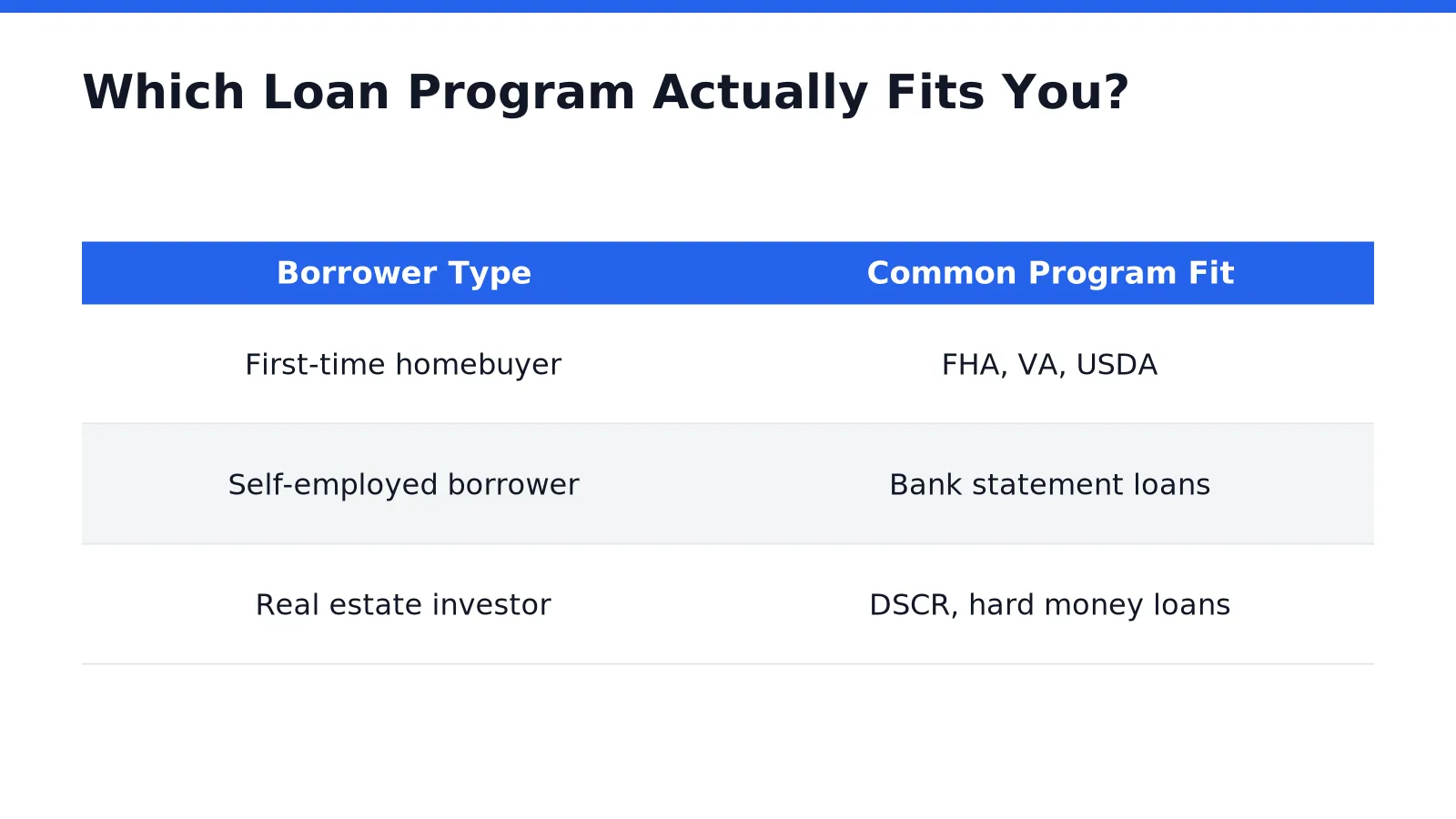
Which Loan Program Actually Fits You?
No single mortgage product works for every borrower. A wide selection of loan programs exists because financial pictures differ: FHA, VA, USDA, and bank statement loans cater to various borrower needs. A salaried first-time buyer, a self-employed contractor, and an investor scaling a rental portfolio each need different underwriting paths. Matching borrower to program, rather than forcing one standard template, is the foundation of sound top mortgage tips for anyone entering the lending process.
Self-employed applicants often struggle with traditional income verification. Bank statement loans solve that problem by evaluating deposits rather than tax returns alone. Investors, meanwhile, frequently turn to DSCR loans, which assess a property’s rental income rather than personal salary, or hard money loans for time-sensitive acquisitions. First-time buyers typically benefit most from FHA, VA, or USDA programs, depending on service history, location, and down payment capacity.
A quick comparison clarifies the fit:
How does a borrower know which loan type to choose?
The right answer depends on income documentation, credit profile, and investment goals, not guesswork. Personalized guidance matters here, since matching the wrong program to the wrong borrower creates delays, denials, or costly refinancing later. Working through this comprehensive mortgage tips list with a knowledgeable loan specialist narrows the options quickly.
Can one lender handle both residential and investment financing?
Yes, provided the lender offers a genuinely wide product range alongside personalized service and consistent integrity. That combination, paired with dependable guidance through every loan program and clear answers at each step, is what builds trust among homebuyers and investors nationwide, and avoiding mismatched financing remains one of the most common mortgage mistakes borrowers can sidestep with the right support.
How Can You Avoid Closing Surprises?
Closing surprises shrink when lenders commit to full transparency from application through funding. Munshi Capital Inc. operates on a mission of transparency, keeping communication honest and clear at every stage of the lending process. That standard, paired with a disciplined review of common mortgage mistakes, prevents last-minute fee shocks and document scrambles.
Borrowers reduce risk by following a structured list of safeguards rather than relying on memory or guesswork. A practical top mortgage tips checklist typically includes:
- Reviewing the loan estimate line by line before signing anything
- Confirming all income and asset documents are current, not outdated
- Asking the loan specialist to explain any fee that looks unfamiliar
- Avoiding new credit applications or large purchases before closing
Why Does Technology Matter Near Closing?
Modern loan tracking tools paired with hands-on loan specialists keep the closing timeline visible and on schedule. Automated status updates flag missing items early, while a dedicated specialist interprets what those updates actually mean for the borrower. This combination closes the gap between a system notification and a clear next step.
What Makes a Lender Trustworthy at the Finish Line?
A borrower-first approach rooted in trust defines a reliable closing partner. Munshi Capital Inc. builds its process on clarity, honesty, and a service-driven ethos rather than fine print and assumptions. Borrowers working through a thorough mortgage tips list before signing arrive at the closing table informed, not ambushed by terms they never saw coming.
FAQ
The content to reformat appears to be cut off after ” Why is mort”: no actual source material was provided for me to extract facts from. Could you please share the complete content you’d like reformatted into the Q&A structure?
I’ll then create 3 question/answer pairs following the exact format you specified, using only the facts present in that content.
Conclusion
In closing, navigating the mortgage landscape requires deliberate attention to financial fundamentals and strategic decision-making at every stage. By prioritizing credit management, maintaining stable employment history, avoiding unnecessary debt accumulation, and securing pre-approval before property selection, borrowers position themselves for favorable terms and streamlined closing processes. The path to homeownership or investment success demands clarity. Transparency throughout, principles that guide our commitment to delivering personalized financing solutions tailored to your unique circumstances and long-term objectives.
Leave a Reply