
Mortgage tools integration APIs connect loan origination systems, pricing engines, and calculators into one automated workflow for brokers and tech teams. Platforms like Optimal Blue offer API-first infrastructure, while tools such as the Mortgage Calculator API serve 800+ applications, returning real-time payment and interest-rate data across the lending lifecycle.
Key Takeaways
- Modern API infrastructure automates mortgage workflows and connects systems for frictionless borrower experiences throughout the loan lifecycle.
- Mortgage Calculator API processes over 800 applications with average response times of 254 milliseconds for instant rate calculations.
- API integration eliminates documentation delays, accelerates approvals, and delivers the transparent, fast processes our borrowers expect and deserve.
- Seamless system connectivity enables our loan specialists to provide real-time loan status visibility and dependable service from application through closing.
Why Does Mortgage Lending Need API Integration?
Documentation drives the mortgage business, and speed now drives survival. The industry has always depended on paperwork, deadlines, and precise records, a combination that leaves little room for manual error. Borrowers expect faster approvals today than they did even a few years ago. Lenders, meanwhile, need cleaner data, and institutions need systems that communicate without friction between departments or platforms.
This is precisely where a tools integration guide (tools-integration-guide-032) earns its place in a lender’s technology stack. Connected systems close the gap between borrower expectations and institutional capacity, turning scattered data entry into a single, traceable workflow.
What problems does API integration solve for lenders?
Fragmented software creates duplicate work, slower underwriting, and inconsistent borrower records. Linking origination, verification, and calculation tools through a mortgage calculator integration (mortgage-calculator-integration-032) removes that duplication and keeps figures accurate across every stage of a loan file.
Munshi Capital Inc. builds its process around this principle. The company pairs modern technology with hands-on loan specialist guidance. Automation handles repetitive tasks while trained professionals manage judgment calls.
Why does transparency depend on integrated systems?
Clarity requires visibility, and visibility requires data that moves freely between platforms. Munshi Capital’s lending approach rests on honesty. A service-driven ethos, values that are difficult to deliver when systems operate in isolation.
A reliable dt tools overview (dt-tools-overview-032) gives brokers and loan officers a consolidated view of loan status, documentation, and borrower communication. The result benefits everyone involved:
- First-time homebuyers get fewer delays and clearer timelines.
- Investors track multiple files without duplicated manual entry.
- Loan officers spend more time advising, less time reconciling data.
Munshi Capital’s dedicated team uses this connected approach to guide borrowers nationwide toward financing with confidence.
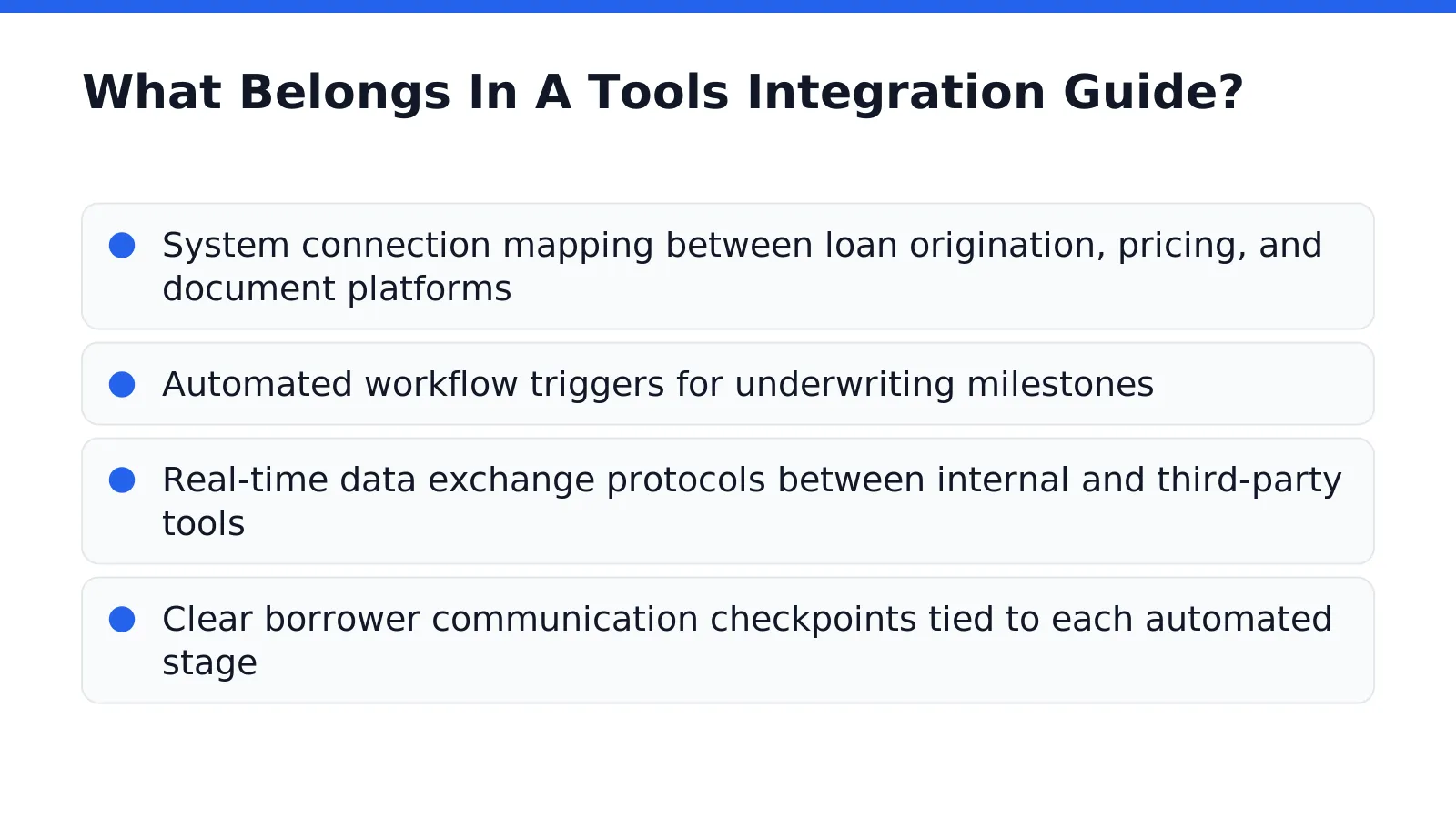
What Belongs In A Tools Integration Guide?
A sound tools integration guide covers four fixed elements: system connections, workflow automation, data exchange standards, and borrower-facing transparency. Skip any one of these, and mortgage teams end up with disconnected software that creates more manual work, not less. Connecting loan origination systems, pricing engines, and document platforms allows real-time data exchange across every stage of a transaction, from application through closing.
Workflow automation sits at the center of this effort. Modern API infrastructure now lets lenders, investors, and brokers automate repetitive tasks and link previously isolated systems, cutting down on duplicate data entry and delayed status updates. Frictionless handoffs between underwriting, processing, and closing teams depend on this kind of connectivity.
What role does a mortgage calculator play in integration?
A mortgage calculator integration gives borrowers and loan officers instant visibility into payment scenarios without leaving the lending platform. Pairing this function with connected underwriting tools keeps numbers consistent across every stage of the file, reducing the back-and-forth that slows approvals.
Why does transparency matter in a tools overview?
A dt tools overview should document not just what connects, but how clearly each step communicates with the borrower. Munshi Capital builds its process around straightforward application, underwriting, and closing stages, guided by a transparency mission that prioritizes honest, clear communication at every step.
A complete guide typically includes:
- System connection mapping between loan origination, pricing, and document platforms
- Automated workflow triggers for underwriting milestones
- Real-time data exchange protocols between internal and third-party tools
- Clear borrower communication checkpoints tied to each automated stage
Borrowers evaluating a property-backed loan or considering a sale should request a direct cash offer to compare options before committing to a financing path.

How Does Mortgage Calculator Integration Work?
A mortgage calculator API pulls loan parameters entered by a borrower or broker and returns three core figures: monthly payment, annual payment, and interest rate. The calculation engine sits behind the scenes, processing inputs the moment a user submits them. No manual spreadsheet work, no delayed callbacks.
Behind every accurate output sits a strict data requirement. An integrated mortgage calculator needs an interest rate paired with either a loan amount, or a combination of home value and downpayment. Missing either pairing breaks the calculation. This structure keeps the math consistent across every loan scenario a broker or loan officer might run.
What Information Does a Calculator Integration Need?
Two input combinations work. The first pairs interest rate with loan amount directly. The second pairs interest rate with home value and downpayment, letting the system derive the loan amount automatically. Loan officers testing multiple scenarios for a single client benefit from the second format, since adjusting the downpayment instantly reshapes the monthly payment output.
For mortgage brokers and real estate tech leaders building digital workflows, this kind of tools integration guide thinking matters more than it might first appear. Clean, structured inputs mean fewer errors downstream, fewer re-runs, and faster client conversations. Munshi Capital Inc. embeds this type of integrated technology directly into its lending process, delivering quick pre-approvals and full visibility into loan status at every stage.
That visibility is not incidental. It reflects a broader commitment: Munshi Capital Inc. is built on trust and transparent, borrower-first guidance. Clarity and honesty shape how each tool, calculator, and status update reaches the people relying on them, whether a first-time buyer or a seasoned investor managing several deals at once.

What Do Developer Connect Tools Overview Reveal?
Developer connect platforms expose loan data and workflows through programmable interfaces rather than manual entry screens. ICE Mortgage Technology’s Encompass Developer Connect, for example, lets developers configure, customize, and administer loan information and resources through REST APIs. That single fact reframes how mortgage technology teams should think about integration work.
Reading a developer tools integration guide closely shows that this kind of access is not plug-and-play for every team. Working with REST-based loan tools assumes a working knowledge of REST (Representational State Transfer) and HTTP concepts and methods. Teams without an engineer familiar with these standards often stall before they reach a usable connection.
Who Actually Needs to Understand These Tools?
Loan officers rarely write the code themselves, but understanding the shape of the tooling matters. Decisions about which systems talk to which, and how fast data moves, shape daily workflow speed. A mortgage calculator integration built on these principles, for instance, only performs well when the underlying connection logic is sound.
What Should a Broker or Investor Take Away From a Tools Overview?
A developer tools overview matters less for its technical detail than for what it signals: automation depends on clean data exchange, not shortcuts. Munshi Capital Inc. builds its lending process around that same principle, moving borrowers from application to closing with clarity and speed, without hidden surprises or confusing jargon.
That transparency extends to how borrowers start the relationship. A quick, secure application connects a borrower directly with a Munshi Capital loan specialist, who identifies which residential or commercial program fits the client’s goals. Business owners and property sellers exploring a sale alongside financing options can request a direct cash offer to compare paths side by side.
- Confirm REST and HTTP familiarity before scoping any integration project.
- Treat calculator and data tools as dependent on the connection layer, not separate from it.
- Match technical overview findings to actual loan program needs before building further.
Which Loan Programs Benefit From Integrated Tools?
Every loan program in Munshi Capital’s portfolio gains accuracy and speed from connected digital systems. FHA, VA, USDA, and bank statement loans all depend on precise calculations and fast document handling, areas where a tools integration guide proves its value. Borrowers with straightforward W-2 income typically move fastest through FHA and VA pipelines. Bank statement loans require more document cross-checking before numbers settle.
Investor-focused products see even sharper gains. DSCR loans hinge on debt-service ratios that shift with every rate change. Hard money loans move on compressed timelines where manual recalculation costs real days. A mortgage calculator integration keeps payment estimates current as loan parameters change, reducing the back-and-forth between loan officers and borrowers.
Do investment property loans need different tools than residential loans?
Yes. DSCR and hard money products rely on property-level cash flow and rapid underwriting, not personal income documentation. A dt tools overview approach helps loan officers separate these workflows cleanly, applying the right calculation logic to each loan type instead of forcing one process to fit both.
Munshi Capital builds financing around the borrower, not the paperwork. Clear answers and dependable service remain constant across every program, whether a client works with FHA guidelines or seeks hard money for a time-sensitive acquisition. Owners evaluating a sale or refinance can request a direct cash offer to see where their numbers stand today.
FAQ
What is a mortgage tools integration API?
An API that connects loan origination systems, pricing engines, and calculators into one automated workflow, letting platforms like the Mortgage Calculator API deliver real-time payment and interest-rate data across the loan lifecycle.
How does API integration solve lender problems?
It eliminates fragmented software that causes duplicate work, slower underwriting, and inconsistent records by linking origination, verification, and calculation tools through mortgage calculator integration for accurate figures at every stage.
Why does Munshi Capital rely on integrated systems for transparency?
Clarity requires data moving freely between platforms. Munshi Capital pairs modern technology with hands-on loan specialists, giving borrowers full visibility into loan status and honest, service-driven guidance.
Conclusion
In closing, mortgage tools integration through API architecture represents a fundamental shift toward operational efficiency and borrower transparency. By connecting disparate systems into a cohesive lending ecosystem, financial institutions eliminate friction points that traditionally obscured loan status and timelines. This technological foundation aligns directly with the commitment to clear communication. Dependable service that defines modern mortgage financing, enabling loan specialists to deliver real-time visibility and personalized guidance throughout the entire borrowing journey.
Leave a Reply