
Mortgage eligibility checks evaluate income, debts, and down payment through Munshi Capital Inc.’s pre-qualification process, giving first-time and self-employed buyers a clear affordability estimate before applying. Borrowers submit financial details, review loan program options, including FHA, VA, USDA, bank statement, and DSCR loans, and receive transparent next steps toward a final, underwritten approval decision.
Key Takeaways
- Income, debts, and down payment are the three primary factors determining your mortgage eligibility.
- Interest rates directly impact your monthly payment, lower rates significantly reduce what you’ll owe monthly.
- Our affordability calculator provides personalized estimates using your accurate financial information for clarity.
- Munshi Capital Inc. offers transparent pre-approvals with full visibility into your loan status throughout.
What Do You Need Before Starting Your Check?
Three categories of documents make an eligibility review accurate: income records, a debt summary, and a target loan program. Gathering these pieces first turns a mortgage eligibility quick check into a reliable estimate rather than a guess built on memory.
Munshi Capital Inc. builds its process around the borrower, offering clear answers through every loan program before a single figure gets entered into a worksheet. First-time buyers, move-up buyers, and self-employed investors arrive with different paperwork, so the starting point varies by borrower type. An eligibility checker guide works only when the right program sits behind the numbers.
Before running any check, confirm the following:
- Identify the loan category that fits the financial picture: FHA, VA, USDA, or bank statement financing, since Munshi Capital Inc. offers all four alongside other residential and commercial options.
- Pull recent pay stubs, tax returns, or bank statements, depending on employment type.
- List monthly debts, including auto loans, student loans, and credit card minimums.
- Note the planned down payment amount, even as a rough figure.
Am I Eligible for a Mortgage With Self-Employment Income?
Self-employed borrowers qualify through alternative documentation, most often bank statements, rather than traditional pay stubs. Lenders still need consistent deposits and a clear debt load. Sorting these records in advance speeds up every later step.
What Counts as Gross Monthly Income?
Gross monthly income means salary before taxes and other deductions leave the paycheck, not the take-home amount. Lenders rely on this pre-tax figure to size an affordable mortgage payment. Co-borrowers combine their gross incomes into one total before calculations begin. Borrowers ready to move forward with firm numbers can request a direct cash offer or request your property assessment to confirm current home value against the figures gathered.
How Do You Run a Mortgage Eligibility Quick Check?
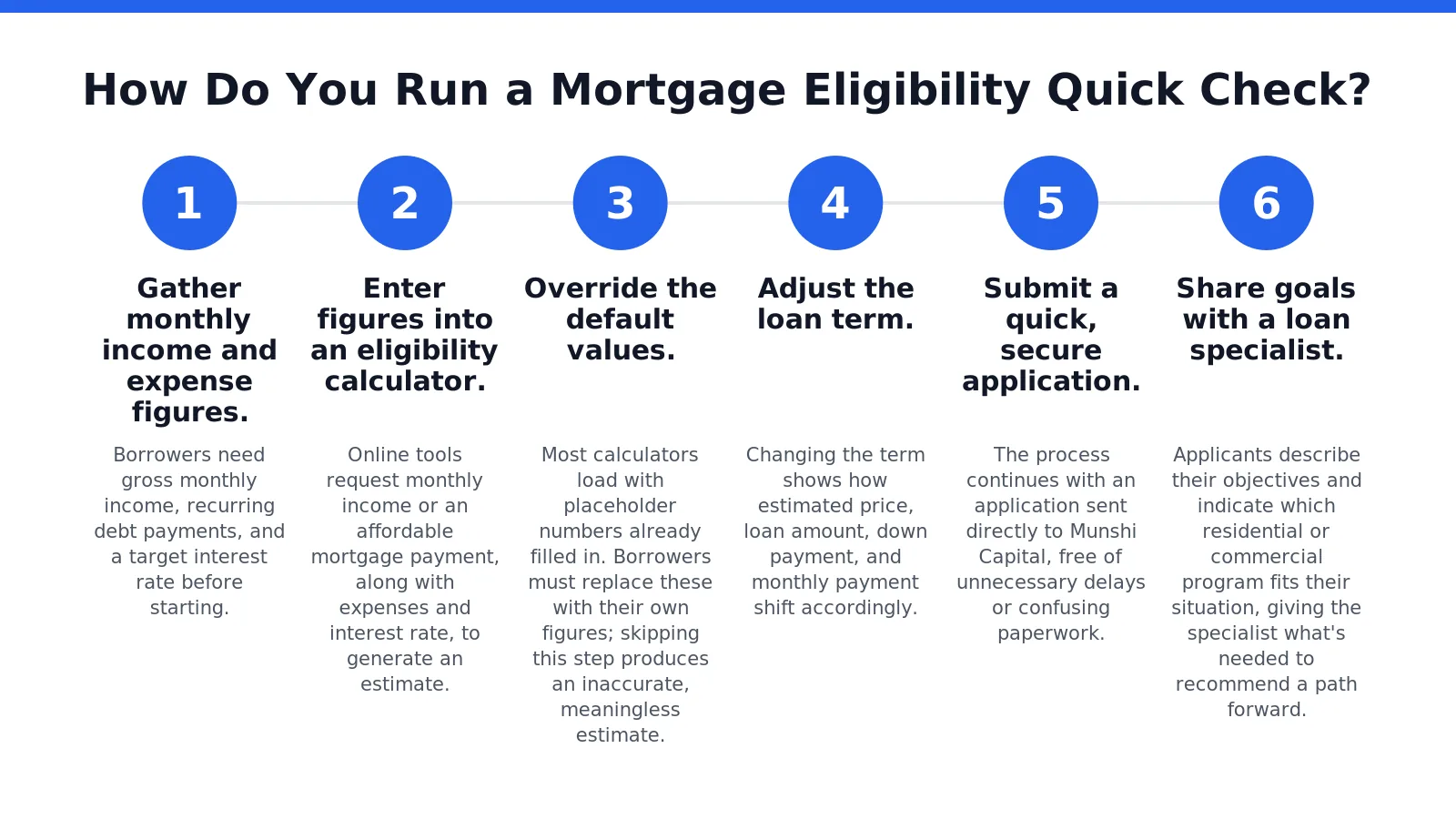
A mortgage eligibility quick check follows a short, defined sequence: submit basic financial details, review an estimate, then confirm those numbers with a loan specialist. No credit pull or lengthy paperwork stands between a buyer and a first answer. The steps below outline the process from start to finish.
- Gather monthly income and expense figures. Borrowers need gross monthly income, recurring debt payments, and a target interest rate before starting.
- Enter figures into an eligibility calculator. Online tools request monthly income or an affordable mortgage payment, along with expenses and interest rate, to generate an estimate.
- Override the default values. Most calculators load with placeholder numbers already filled in. Borrowers must replace these with their own figures; skipping this step produces an inaccurate, meaningless estimate.
- Adjust the loan term. Changing the term shows how estimated price, loan amount, down payment, and monthly payment shift accordingly.
- Submit a quick, secure application. The process continues with an application sent directly to Munshi Capital, free of unnecessary delays or confusing paperwork.
- Share goals with a loan specialist. Applicants describe their objectives and indicate which residential or commercial program fits their situation, giving the specialist what’s needed to recommend a path forward.
What Information Does an Eligibility Checker Need?
An eligibility checker guide typically asks for income, debt obligations, and a desired interest rate. Some tools also request a target monthly payment instead of income, letting borrowers work backward from a budget they’re comfortable with.
Is a Quick Check the Same as Pre-Approval?
No. A quick check produces an estimate only; it carries no guarantee of financing. Borrowers asking am I eligible for a mortgage need a loan specialist to confirm figures and move toward formal underwriting.
Sellers weighing a sale alongside a purchase can request a direct cash offer. Homeowners unsure of value can request your property assessment before setting a budget.

Am I Eligible for a Mortgage, Really?
Mortgage eligibility hinges on matching a borrower’s financial profile to the right loan program, not on a single number or test. Munshi Capital Inc. builds its residential and commercial loan programs around this idea, serving first-time homebuyers, move-up buyers, business owners, and seasoned investors with options tailored to each financial picture. A self-employed investor and a first-time buyer rarely qualify the same way. The honest answer to am I eligible for a mortgage depends on documentation, debt, and the loan product chosen.
A dependable eligibility checker guide follows a clear sequence. Before starting, applicants should have income records, a list of monthly debts, and a target down payment ready.
- Gather recent income documentation, including pay stubs, tax returns, or bank statements for self-employed applicants.
- List all recurring monthly debts, from auto loans to credit cards.
- Identify the intended down payment amount and loan term.
- Run a mortgage eligibility quick check using those figures to see an estimated price range.
- Treat the output as a starting point, not a final answer.
- Contact a mortgage lender directly to review personalized financing options.
Does a quick eligibility check guarantee loan approval?
No. A quick-check result is an estimate only and does not indicate approval or financing of an actual mortgage loan. Final qualification requires full underwriting review, so the estimate serves as a planning tool rather than a commitment.
What signals a trustworthy mortgage lender?
Integrity, personalized service, and a wide range of loan products separate dependable lenders from the rest. These qualities build the kind of nationwide trust that homebuyers and investors rely on when financial pictures get complicated. Borrowers who confirm those signals early avoid delays and surprises later in the loan process.
What Happens After Your Eligibility Check Clears?
A cleared eligibility check moves a borrower directly into Munshi Capital Inc.’s application, underwriting, and closing process. Lenders that skip clear sequencing leave borrowers guessing about timelines and documentation, often costing weeks of avoidable back-and-forth. Munshi Capital Inc. built its process around clarity instead, so borrowers understand each stage before reaching it.
Following an eligibility checker guide keeps the transition from pre-qualification to formal application organized rather than chaotic. The sequence below outlines what typically follows a cleared check:
- Submit the formal loan application, confirming the income, debt, and down payment figures used during pre-qualification.
- Provide supporting documentation requested by the underwriting team, including bank statements or tax records depending on loan type.
- Allow the underwriting team to verify eligibility details and finalize loan terms.
- Review the closing disclosure and schedule the closing date with a loan specialist.
Technology plays a direct role in keeping this sequence fast. Modern processing systems, paired with the hands-on attention of dedicated loan specialists, produce quick pre-approvals and give borrowers full visibility into loan status at every stage. No borrower is left wondering where a file stands.
What’s the First Move After Pre-Qualifying?
The first move is starting a preapproval online once an affordable price range becomes clear. A loan specialist follows up directly afterward to confirm details and guide next steps.
Does Clearing Eligibility Guarantee Approval?
Clearing a mortgage eligibility quick check signals strong footing, not a guarantee. Underwriting still verifies every document before final approval. Borrowers determining whether they are eligible for a mortgage should treat the initial check as a starting point, not the finish line.
What Mistakes Derail Mortgage Eligibility Checks?
Incomplete financial pictures derail most mortgage eligibility checks. Buyers who estimate affordability using income alone, while ignoring debt load and down payment size, receive skewed results that mislead their house hunt. Mortgage affordability calculator: What house can I afford? identifies income, debt, and desired down payment as the core factors lenders weigh together, not in isolation. Leaving any one of these out produces a number that collapses once underwriting begins.
Self-employed borrowers and move-up buyers face an added risk: relying on guesswork instead of structured review. A proper mortgage eligibility quick check accounts for variable income, existing obligations, and savings goals simultaneously. Skipping this step wastes time on homes outside true reach.
Why does working with a loan specialist matter for eligibility accuracy?
Guesswork invites costly missteps. Personalized guidance from a dedicated team helps borrowers secure financing with confidence, rather than estimating eligibility alone and risking a mismatched budget. This structured, borrower-first support forms the basis of a proper eligibility checker guide, catching gaps that self-service tools miss.
What should a borrower verify before asking, “am I eligible for a mortgage”?
Borrowers should confirm income documentation, outstanding debt, and intended down payment before running any check. Common derailers include:
- Overlooking recurring debt payments that reduce borrowing capacity
- Underestimating the down payment needed for a target price range
- Skipping professional guidance in favor of unverified estimates
A reliable lending partner, built on trust and committed to transparent, borrower-first guidance, keeps the process rooted in clarity and honesty from start to finish.
FAQ
What documents do I need before starting a mortgage eligibility check?
Gather income records, a debt summary, and a target loan program first. Pull recent pay stubs, tax returns, or bank statements, list monthly debts, and note a rough down payment amount.
How does Munshi Capital Inc. verify income for self-employed borrowers?
Self-employed borrowers qualify through alternative documentation, most often bank statements, instead of traditional pay stubs. Lenders look for consistent deposits and a clear debt load before confirming eligibility.
What happens after I complete a mortgage eligibility quick check?
Borrowers submit basic financial details, review an affordability estimate, and then confirm those numbers with a Munshi Capital Inc. loan specialist. This leads toward transparent next steps and a final underwritten approval decision.
Conclusion
In closing, understanding what to expect from a mortgage eligibility checker positions you to approach the lending process with confidence and clarity. By evaluating your financial profile objectively, you gain actionable insight into your borrowing capacity and the loan programs suited to your circumstances. This foundational knowledge eliminates uncertainty and enables you to move forward decisively toward homeownership or investment objectives. Armed with transparent information and personalized guidance throughout your loan journey, you are equipped to make informed decisions that align with your financial goals.
Leave a Reply